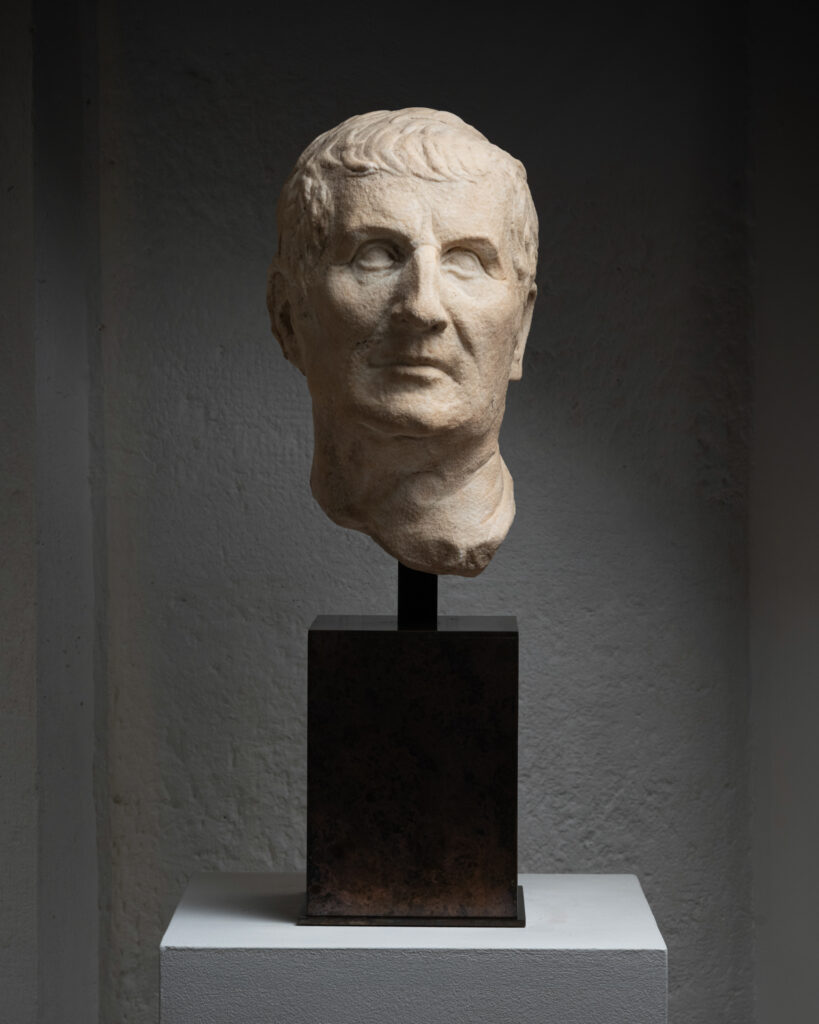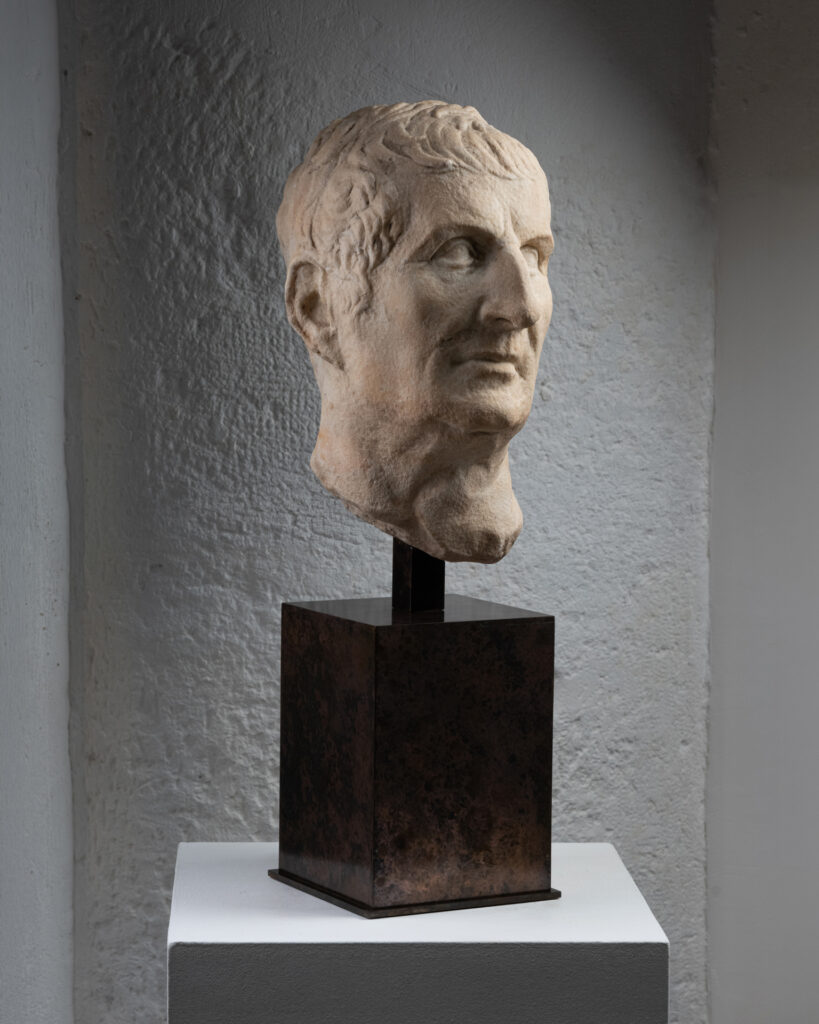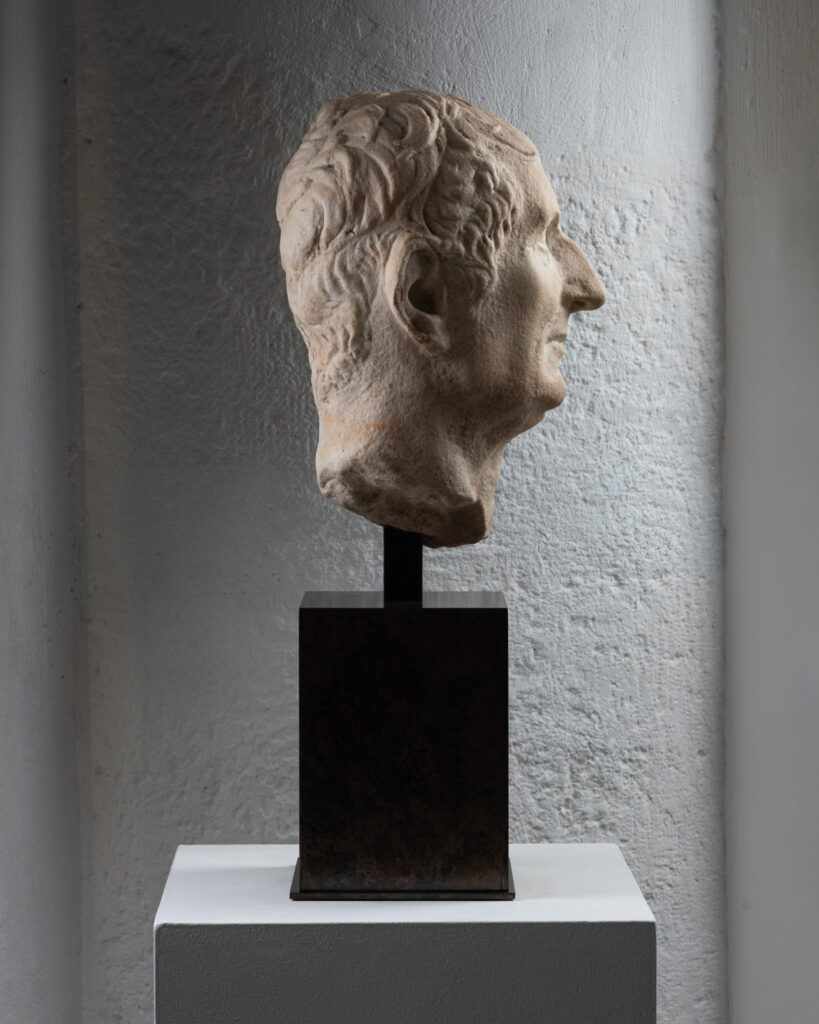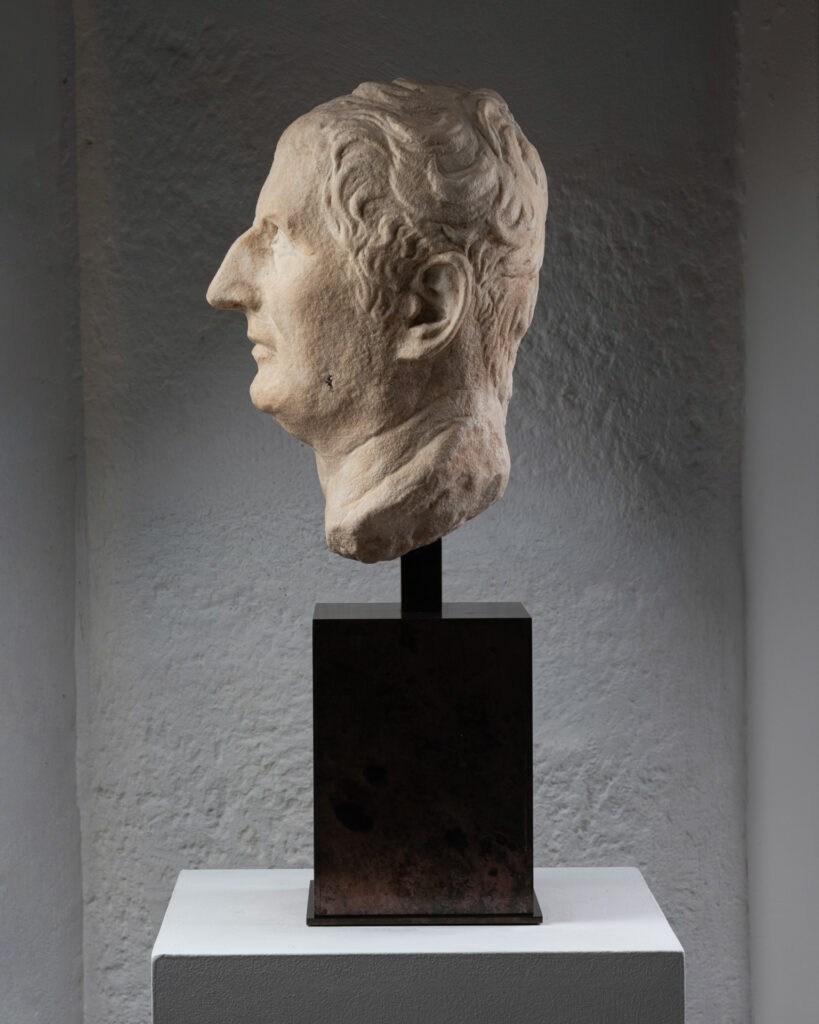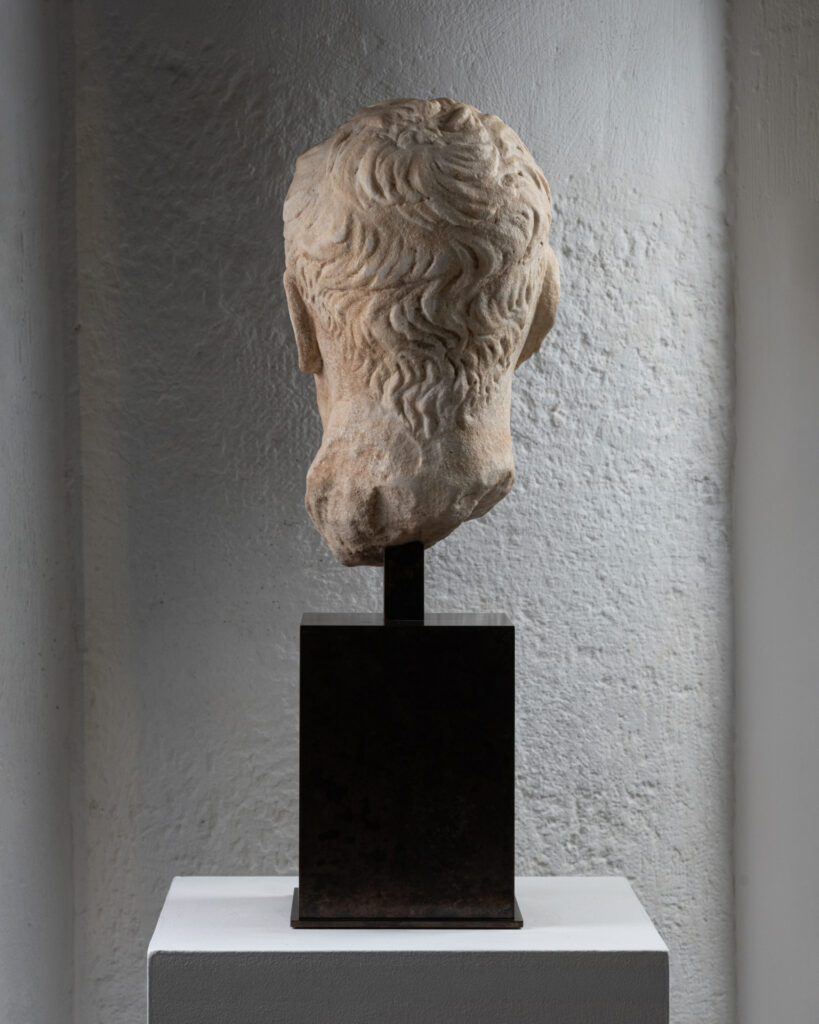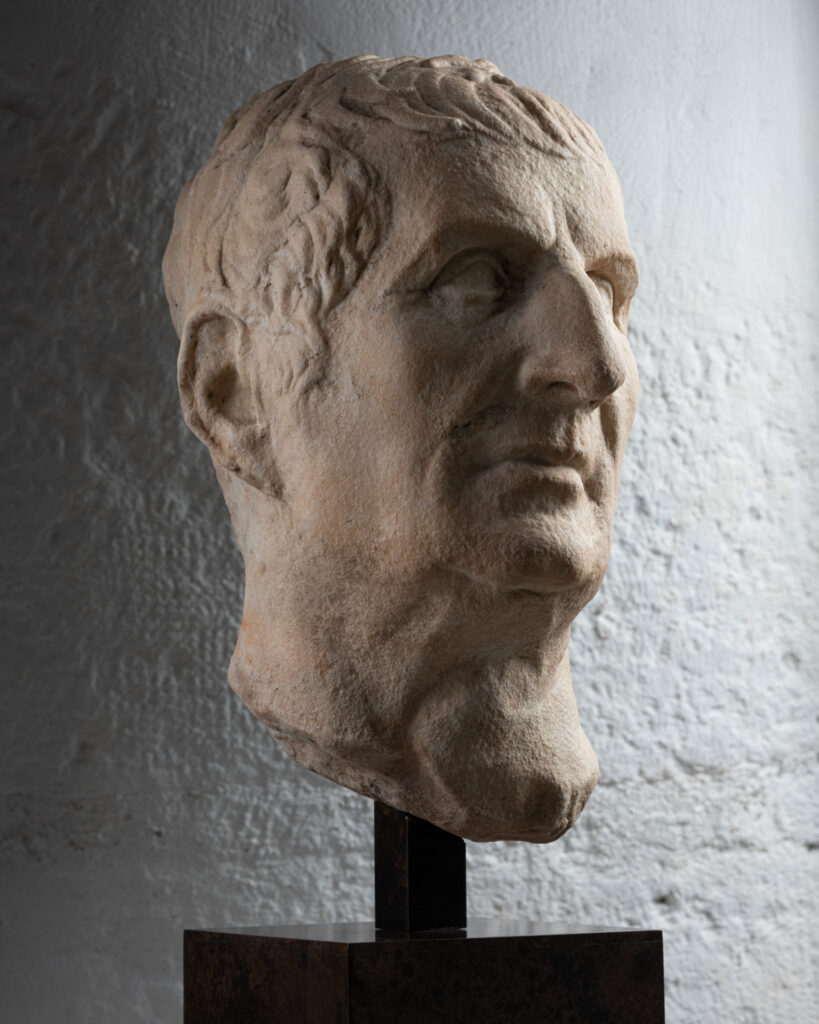

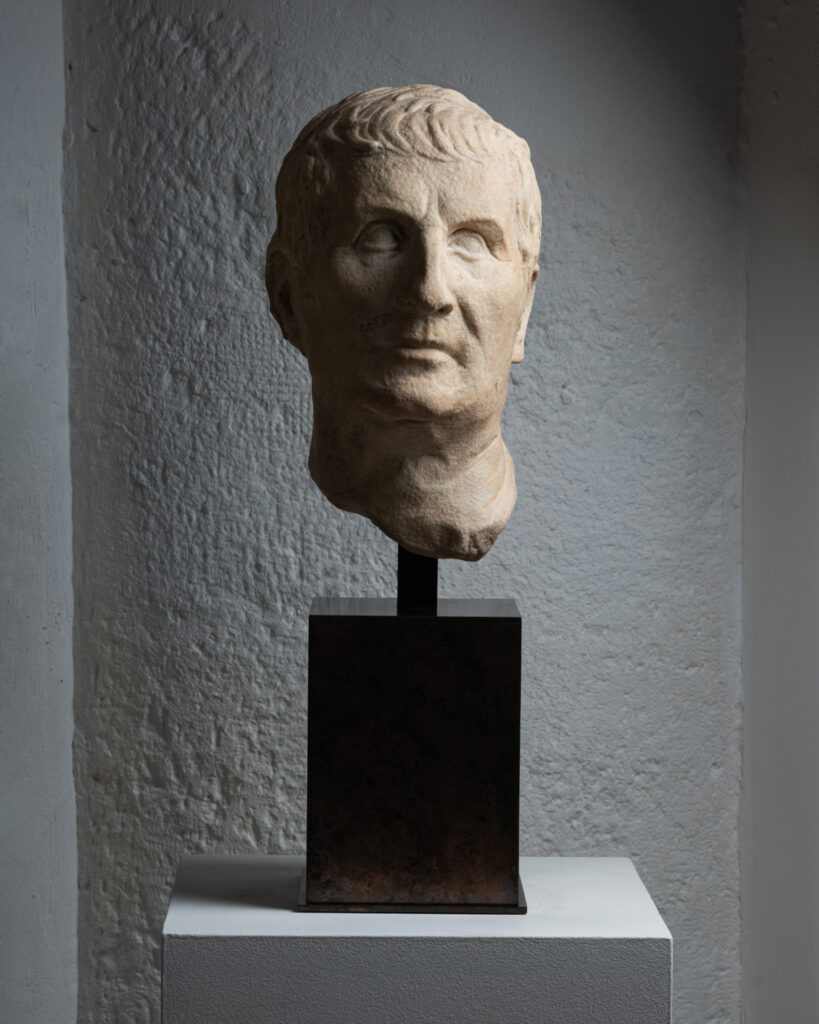
This remarkable male head in white marble depicts an adult or middle-aged man, beardless, whose face is distinguished by strong individual facial features: a high, broad forehead; a large skull; and a relatively narrow, elongated face. The most characteristic feature is the long, strongly aquiline nose, complemented by a thin, slightly receding mouth and a relatively small but distinctly projecting chin. The eyes, now heavily worn, were deeply set beneath pronounced brow ridges; the short hair, arranged in soft, closely spaced strands falling over the forehead and extending around the temples and ears, contributes to the work’s overall asceticism. Through this sober and realistic treatment, which emphasizes individual characteristics rather than a generic image of a Roman, the sculpture is part of the great tradition of realistic portraiture inherited from the late Republic. The work’s state of preservation is exceptional in this regard: the head has not undergone any restoration, and the nose—the most fragile element and the one most frequently reconstructed in this type of sculpture—is entirely original. Such integrity is particularly rare for a piece of this age.
The date can be estimated as around 30 B.C. – 50 CE, with a preference for the first half of the 1st century CE, and more specifically for the Julio-Claudian era—a period when this Republican vocabulary was still particularly vibrant, conveying an assertion of personality based on authority, experience, and dignitas.
The facial features invite several comparisons with the great portraits of the late Republic and early Empire. The most striking comparison is with Tiberius: his portrait, housed at the Saint-Raymond Museum in Toulouse—discovered in Béziers and dated to 14–23 AD—features an “eagle-beak nose,” a “recessed” mouth, a “small, protruding, and clenched” chin, as well as a prominent skull and forehead—all precise correspondences that make this comparison particularly interesting. Comparisons with portraits traditionally associated with Marcus Licinius Crassus, Julius Caesar, or Cicero are also possible. They serve as a reminder, however, that Roman portraiture could incorporate physical features associated with the great figures of the Republic without the subject necessarily being one of those individuals: several portraits now considered private were thus, in antiquity as well as in modern historiography, linked to famous figures before their non-imperial or unidentifiable nature came to be emphasized. These comparisons should therefore be understood as iconographic affinities and as a reflection of a representational language, rather than as arguments in favor of a precise identification.
It is this last possibility that seems the most promising here. Rather than forcing an identification with Tiberius, Crassus, Caesar, or Cicero, it is preferable to consider the head as the portrait of a private individual of very high rank, belonging to the Roman elite or to a deeply Romanized provincial circle—a man influential enough to commission his own portrait, but who chose to align himself with the legacy of the great republican figures rather than resort to explicit imperial attributes, hence the absence of a laurel wreath or any element that would allow for an official identification with an emperor. Several male portraits in the collections of the British Museum and the Metropolitan Museum confirm that high-ranking men could be depicted with highly individualized features, even though precise historical identification is no longer possible today. This visual choice is by no means insignificant: in a society where authority, seniority, gravitas, and dignitas were essential values of representation, being portrayed in the spirit of a great republican figure was a significant way to assert one’s status.
This approach can be explained by the very purpose of the sculpted portrait in the Roman world: a practice reserved for the elite—magistrates, high-ranking officials, military officers, landowners, wealthy merchants, and municipal dignitaries—who had the means to commission a marble work and display it in a suitable location. Far from aiming solely for physical resemblance, the work served to highlight a social status, a life journey, and family or civic ties, while ensuring a lasting presence for the subject. It might be commissioned upon assuming an official office, following an achievement, or in old age when experience itself became a quality worth showcasing; or it might be installed after death as part of a tradition of family remembrance. This latter rationale, moreover, aligns with an aesthetic trait specific to the late Republic: unlike the Greeks, who idealized faces, the Romans of this period, on the contrary, valued age, austerity, and even the physical marks of time. If the work belongs to this so-called “realist” tradition, wrinkles, receding hairlines, or mature features were therefore not flaws to be concealed, but visible proof of a man’s auctoritas and his dedication to the service of Rome—an aging that was embraced, almost claimed as a merit. Depending on the subject’s status, the work would then find its place in a private residence, a tomb, or a public space. For a provincial notable in particular, owning and displaying such a portrait was a privileged way of aligning oneself with the norms of the Roman elite.
With its powerful features, exquisite craftsmanship, and the rarity of its original condition, this head offers much more than an archaeological artifact: it provides direct, almost unaltered insight into the perspective of a man from the early days of the Empire—a piece of extraordinary presence and authenticity.