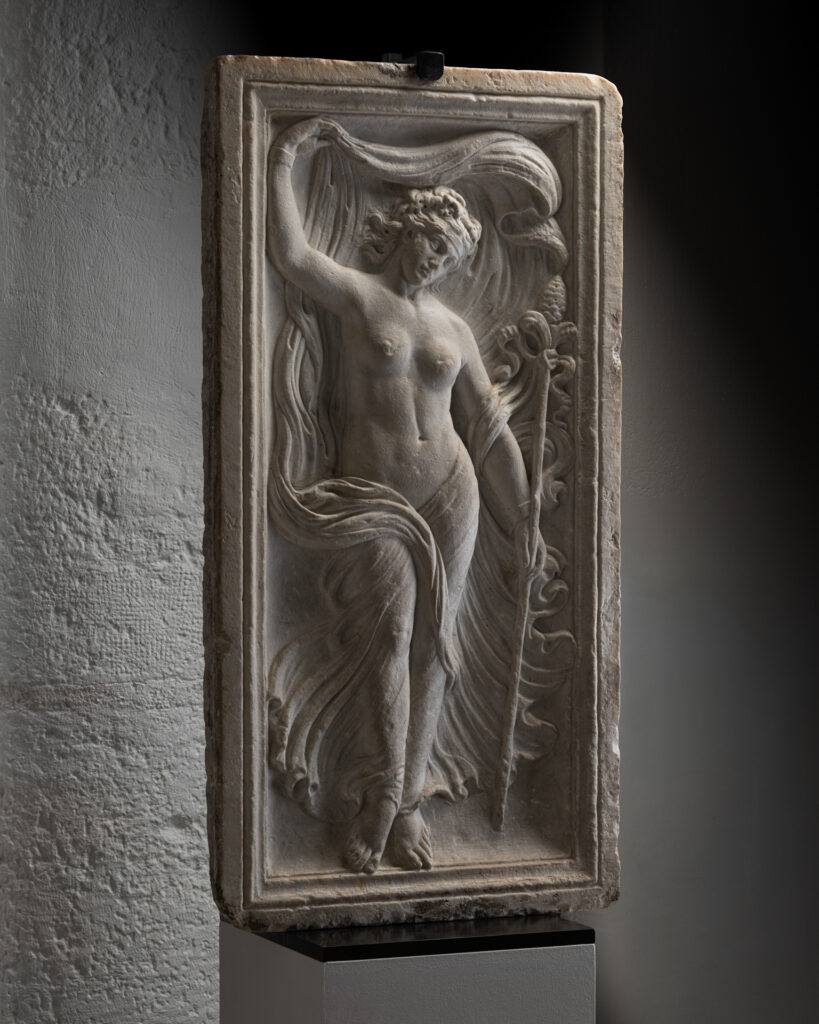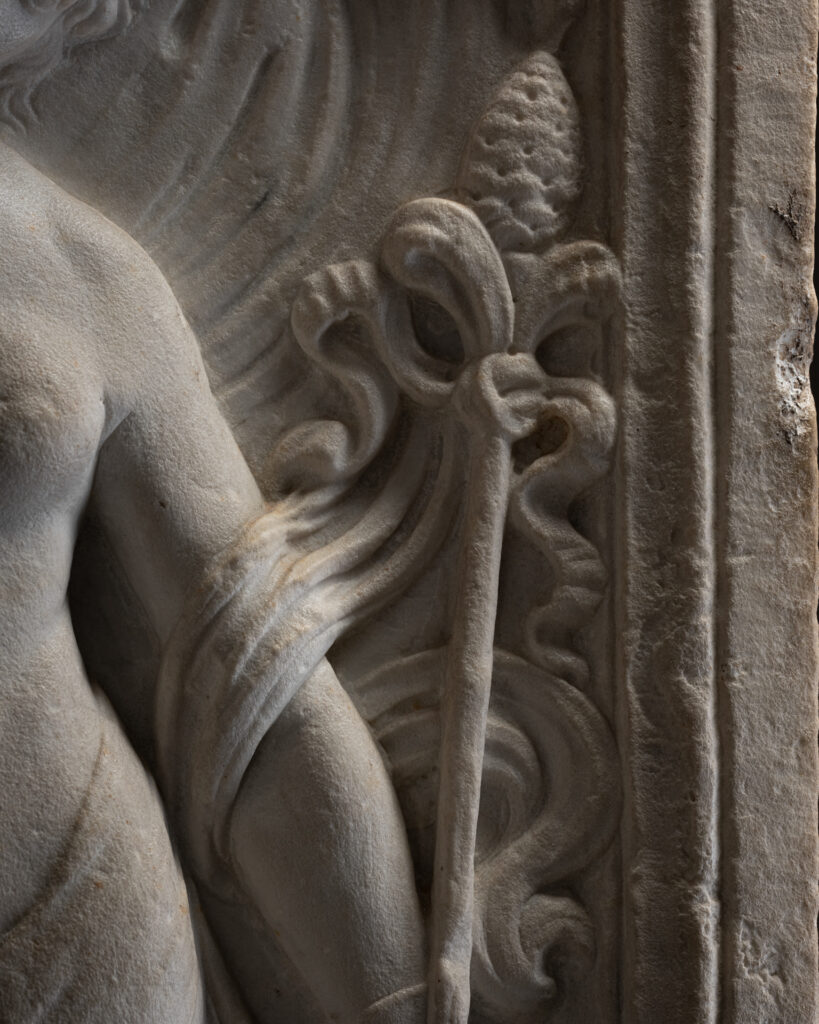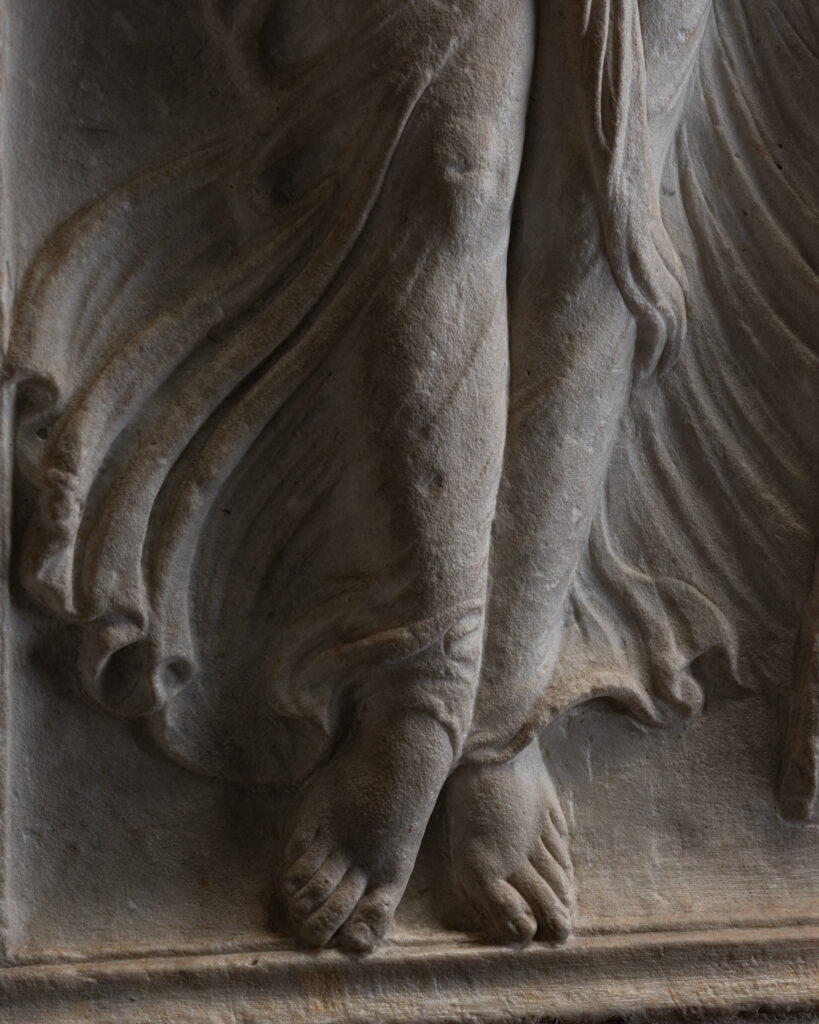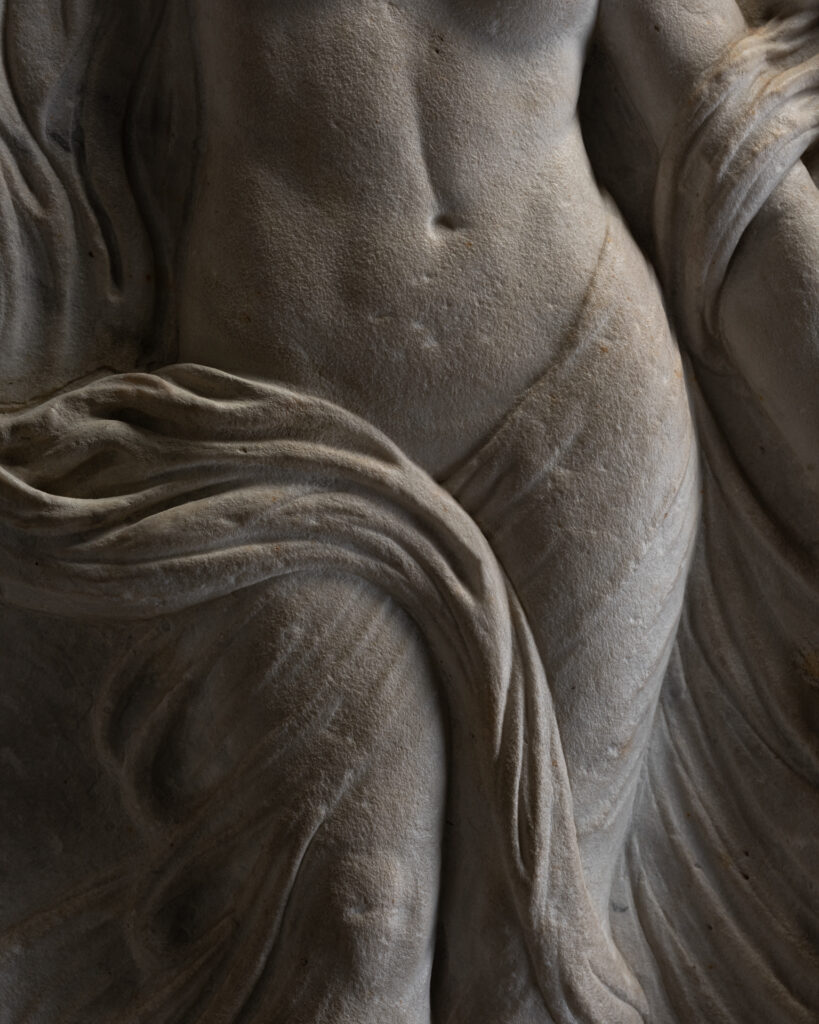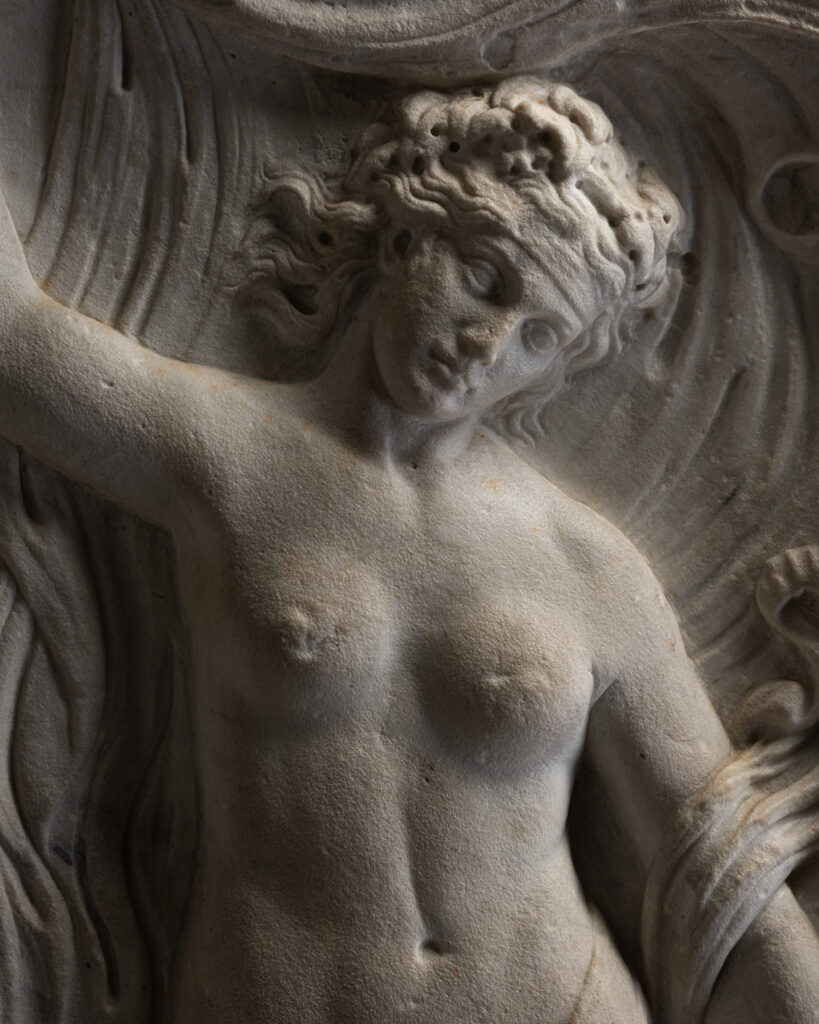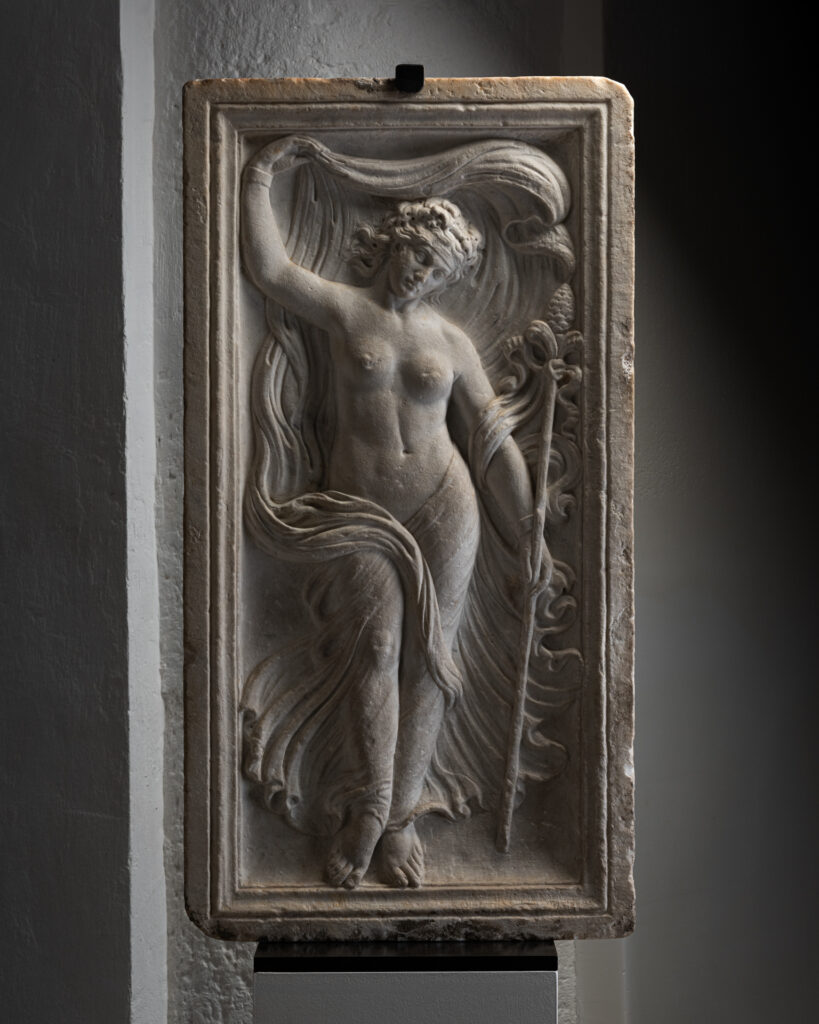
This rectangular marble slab, framed by a moulded border carved from a single block, depicts an almost naked female figure captured in the midst of a dance. Standing with her hips slightly swayed, she raises one arm above her head to hold back a large, billowing veil that forms an arc around her. In her other hand, she holds a long staff adorned with a knotted ribbon and topped with a pine cone: a thyrsus, an attribute of Dionysus. She is therefore a Maenad, or Bacchante, a follower of the god in the Bacchic procession. Her torso is bare and a flowing drape wraps around her hips and legs, hugging her form whilst creating numerous folds. Her head, tilted slightly, conveys an almost detached calm, far removed from the ecstasy usually attributed to bacchantes. Her curly hair, adorned with plant motifs, is pierced with small drill holes. Her large, almond-shaped eyes have neither irises nor pupils carved into them: the gaze arises solely from the volume of the eyeballs and the shape of the eyelids. Smooth bracelets encircle her wrists and a taenia, a ribbon worn around the forehead, discreetly adorns her face.
The figure stands out clearly against the background, whilst the background itself and certain sections of the veil retain the understated quality of the stiacciato technique. The reverse, which is thick, rough and pitted, has no finish comparable to that of the obverse. It bears a continuous ochre patina that extends down into the recesses; the edges are blunted and the borders show minor signs of wear and loss. Taken as a whole, the piece suggests a plaque intended to be set or incorporated into a decorative feature – such as an architectural panel, a fireplace, or furniture in a palace or cabinet – rather than a marble sculpture designed to be viewed in isolation. This intended use is valuable for the investigation: it points to sculptors whose figures were designed to be integrated into non-religious architecture.
The subject matter is the strongest aspect of the research carried out on this piece. The dancing maenad is one of the major themes of ancient sculpture: large-scale reliefs, often nearly 1.5 metres high, held notably at the Metropolitan Museum in New York, the Gardner Museum in Boston, the Uffizi or the Louvre, are derived from a 5th-century BCE Greek prototype which tradition attributes to Callimachus. These figures, with their sweeping dance, flowing veils and thyrsus, were copied extensively during the Roman period, in the so-called Neo-Attic style, and it was in this form that the Renaissance came to know them. Italian artists of the fifteenth and sixteenth centuries had these reliefs, these Dionysian sarcophagi, these gemstones and these coins before their eyes; they sketched them, circulated them as drawings, bronze plates and prints, and freely reinterpreted them. Our maenad is part of this tradition, whose drawings and prints also carried its language beyond the Alps. However, she does not copy any known example: the tilted head, the bare bust, and the arrangement of the veil and the thyrsus all differ both from the absorbed type derived from Callimachus and from the menad thrown back in ecstasy of the so-called Dresden type. This divergence is precisely what one would expect from a Renaissance work, which draws inspiration from antiquity without merely reproducing it.
The date adopted as a working hypothesis is therefore the mid-16th century, within a Mannerist context shared by Italy and France. Several features point in this direction. The taste for classical nudes and for ‘wet drapery’—which hints at the body whilst multiplying the folds—is common to all all’antica sculpture of the period. The pose – theatrical and with a swaying hip – the contrast between smooth flesh and deep folds, and the ambiguity between scholarly allusion and modern invention all reflect a sensibility which, following the balanced compositions of the early 16th century, sought elegance, virtuosity and movement. The use of a trephine to carve the curls, initially favoured by Roman sculptors, was adopted by Renaissance artists seeking to recreate the sense of depth found in ancient marble sculptures. Finally, the ‘virgin eyes’ find their equivalent among 16th-century Italian sculptors, notably in the all’antica female busts and reliefs produced by the Lombardo circle, which in this respect differ from the style of their masters, who systematically carved the gaze.
This Mannerist style was not confined to Italy: it spread to France via Fontainebleau, which became one of its main centres. The château, which Francis I transformed from 1528 onwards into a showcase for a new art form, was decorated almost entirely by artists from the Italian peninsula: Rosso Fiorentino, a Florentine trained in Michelangelo’s circle, arrived in 1530; Primaticcio, trained in Mantua under Giulio Romano, joined him around 1532; Benvenuto Cellini stayed in France from 1540 to 1545; Serlio introduced Italian architectural thought to the country. Antiquity was present there first-hand: Primaticcio was sent to Rome to acquire antiquities and have others cast, including the most famous ones, so that the Roman models served as the starting point for bronzes cast in France. And this artistic language did not remain confined to the château; prints based on compositions by Rosso and Primaticcio disseminated it widely, particularly amongst Parisian artists. It was through this channel that many French artists—of whom we have no record of a stay in Italy—acquired, in particular, the repertoire of nymphs, female nudes and drapery in the classical style. A French connection therefore does not take us away from Italy: it implies a body of work created in France, yet nourished by the Italian culture that had taken root there, in a world where artists, models and artistic forms were constantly moving from one side of the Alps to the other.
It was in the work of Jean Goujon and his studio that we found the most similarities. Goujon introduced three major themes from ancient art into the French Renaissance: putti, nymphs, and female nudes. To achieve this, he drew inspiration from Italian Renaissance models, but he reinterpreted and elevated them through a new artistic language. This style flourished even further in the allegorical figures adorning the spouts of the Fontaine des Innocents, where female figures are set between pairs of pilasters, following a principle found in the so-called Arch of the Argentiers in Rome. Goujon, however, was able to draw on more recent examples he had seen in Italy: in Rimini, Agostino di Duccio also placed, in the interior decoration of the Tempio Malatestiano, allegorical reliefs between two fluted pilasters—figures proportioned to the architecture that houses them, whose graphic folds with sinuous curves offer a reinterpretation of the ancient style of wet drapery. Our relief shares with Goujon’s figures—notably those of the Fountain of the Innocents and the Peace on the Lescot wing—hip-swaying bodies, drapery that conforms to the anatomy, smooth bracelets, and hair carved with a trephine. The faces are also similar: the same idealized features, the same large almond-shaped eyes, whose modeling alone defines the gaze. The relief occupies the same distinctive position: the maenad displays deep relief on her body, while the background and certain sections of the veil retain the restraint of the stiacciato technique. Finally, the rough and irregular reverse side of our plaque resembles that of the Goujon relief, the reverse of which we were able to compare. We present this comparison with caution: it is based on a set of stylistic features, not on a documented work whose composition has been replicated, and we are referring to a workshop or circle rather than the master’s own hand.
Agostino di Duccio, whom we have just examined in the context of Goujon, sheds light on the genealogy of this style whilst also raising questions regarding authorship. His reliefs at the Tempio Malatestiano in Rimini (c. 1450–1457) and the Oratory of San Bernardino in Perugia are renowned for their stiacciato, an extremely flattened relief technique in which the figure seems to emerge almost from the line drawing and the drapery, pressed against the body, appears to float in the wind. His depictions of deities in Rimini, notably the Moon, offer a repertoire of half-clad female figures and billowing veils which, a century earlier, foreshadowed what Mannerism would later take further. Our maenad differs from these in part: she displays deep relief on her body, whilst the background and certain folds of the veil retain the restraint of the stiacciato, and the burin carves vivid shadows into her hair. Two panels from the Tempio, however, deviate from Agostino’s usual style: their relief is less flattened and their drapery, held by a woman’s hand, is very reminiscent of ours, with light work using a trepan [specify which ones]. They may be the work of someone other than Agostino himself, and one’s thoughts turn to his brother Ottaviano, a goldsmith and sculptor who arrived in Rimini in 1456. We put forward this hypothesis with caution: it remains to be verified in the literature on the building site. Agostino and his circle are therefore not proposed as the creators of the piece, but as points of reference for gauging the transition from line to the substance of the marble.
Research into this piece has extended far beyond these names. We have compared the Maenad with marbles and bronzes from the Lombard and Venetian Renaissance, notably the works of Tullio, Antonio, Pietro and Aurelio Lombardo, those of Cristoforo Solari and Bambaia, Simone Bianco and Gian Giacomo della Porta, as well as to late 15th-century bronze plaques, such as the hexagonal plinth depicting a Dionysian procession at the Palazzo Venezia, which attests to the circulation of a repertoire of dancing maenads in the decorative arts of northern Italy. At Fontainebleau, we also looked at works by Rosso and Primaticcio, but neither the serpentine line nor the elongated proportions are clearly evident in our plaque, which adheres to a fuller and more understated form. Each of these references, apart from Goujon, contributed only one element: a type of face, a depth of relief, a way of sculpting the hair, a flowing drape, a bracelet. Goujon is the only artist in whose work we found almost all of these features together: the swaying figures, the drapery that follows the contours of the body, the smooth bracelets, the trefoil motif in the hair, the large almond-shaped eyes and, based on a relief we were able to compare, the style of the reverse. It is this combination of features, rather than any single detail, that leads us to focus on him and his workshop. Ainsi, si plusieurs caractéristiques de notre plaque trouvent des parallèles dans l’oeuvre de Goujon et de son entourage, nous n’avons toutefois identifié aucun relief réunissant l’ensemble de ces éléments. Ni les particularités techniques — yeux entièrement vierges au modelé très marqué, relief profond dans un cadre mouluré et revers brut destiné au scellement — ni les motifs iconographiques — voile gonflé au-dessus de la tête, thyrse rubané, buste découvert et tête inclinée — ne trouvent de correspondance intégrale dans une oeuvre connue. Thus, whilst several features of our plaque find parallels in the work of Goujon and his circle, we have not, however, identified any relief that brings together all of these elements. Neither the technical features — entirely unadorned eyes with very pronounced modelling, a deep relief within a moulded frame and a rough reverse side intended for embedding — nor the iconographic motifs — a billowing veil above the head, a ribboned thyrsus, an uncovered bust and a tilted head — find a complete match in any known work.
Based on current knowledge, the work is still attributed to a circle rather than to a single artist, and this is what makes the piece so unique. It is tentatively linked to Goujon’s workshop or circle on the basis of a number of stylistic features, but we know of no maenad holding a thyrsus of this type in his body of work. Many reliefs can be easily categorised: a copy of a famous model, a follower’s reinterpretation of a master’s composition, or a standard workshop production. This piece defies such categorisation: whilst it is close to a recognisable style, it does not replicate any known example. It combines classical vocabulary, Renaissance sculptural depth and Mannerist elegance with a freedom of composition that makes any hasty comparison impossible. In this sense, its association with Goujon’s workshop adds a previously unknown figure to the body of work of one of the great sculptors of the French Renaissance. It is this dual singularity—a name that is taking shape and a missing model, rather than a name alone—that, in our view, accounts for the rarity and interest of this plaque.
The dancing maenad embodies, first and foremost, the sacred ecstasy that the Greeks called *enthousiasmos*: the state of one who is filled with the god. In the procession of Dionysus, she represents the abandonment of self-control under the influence of wine, music and dance – a ritual intoxication experienced as a communion with the deity rather than as mere excess. The thyrsus she brandishes—a staff wrapped in ivy and vine shoots and crowned with a pine cone—evokes plant vitality, the vine and the cyclical renewal of nature, for she accompanies a god who dies and is reborn. The myth also attributes a dark side to her, as seen in Euripides’ *The Bacchae*, where the very same frenzy that liberates can also destroy. Everything about this figure’s body conveys this trance: the swaying of her hips, her raised arm, the large veil billowing with her movement, and the drapery pleating around her legs. The face, however, is strikingly calm. It displays neither the laughter nor the grimace one would expect from a Bacchante, and the expression, almost detached, seems at odds with the body’s agitation. One can discern in it the tension characteristic of art inspired by Antiquity: a body carried away and an idealised face, undistorted by frenzy. One can also see in it the mark of the trance itself, for the possessed person is ‘out of herself’ (ekstasis) and appears oblivious to her surroundings. The large eyes, left without engraved irises or pupils, reinforce this impression: her gaze is directed at no one; the figure dances in a time that is not that of the viewer. Like her gaze, the Maenad eludes us: we seek her in Italy or France, from ancient art to the Renaissance; she still dances and remains silent.