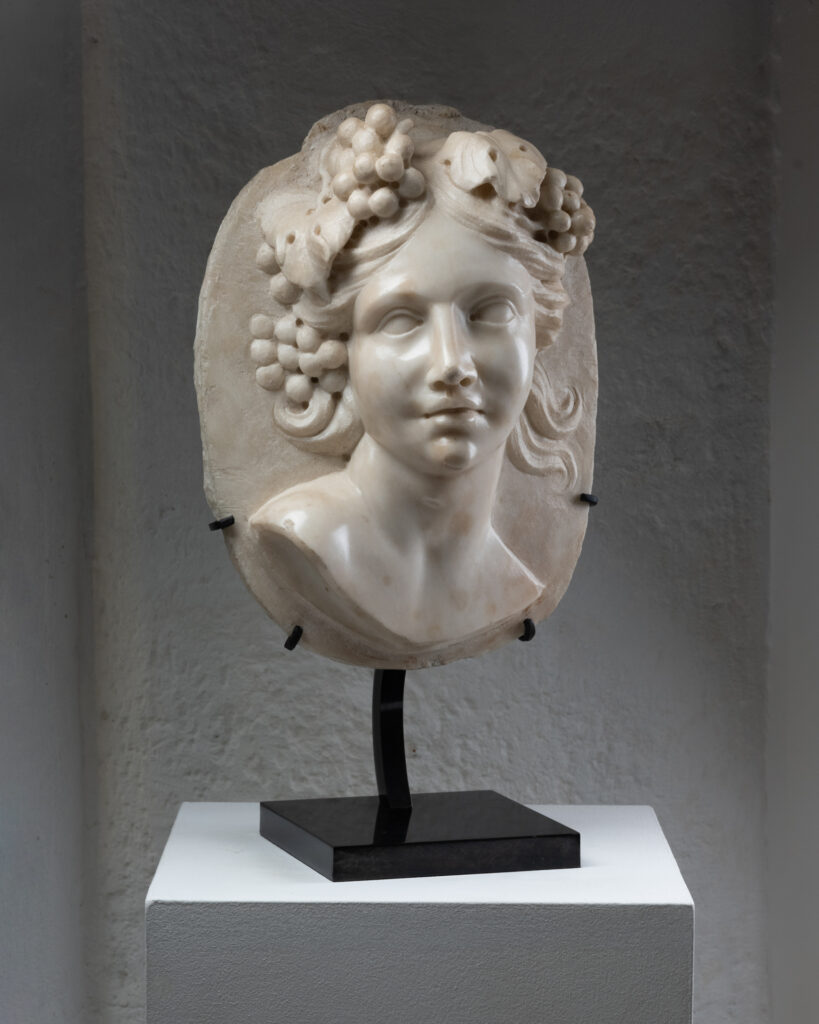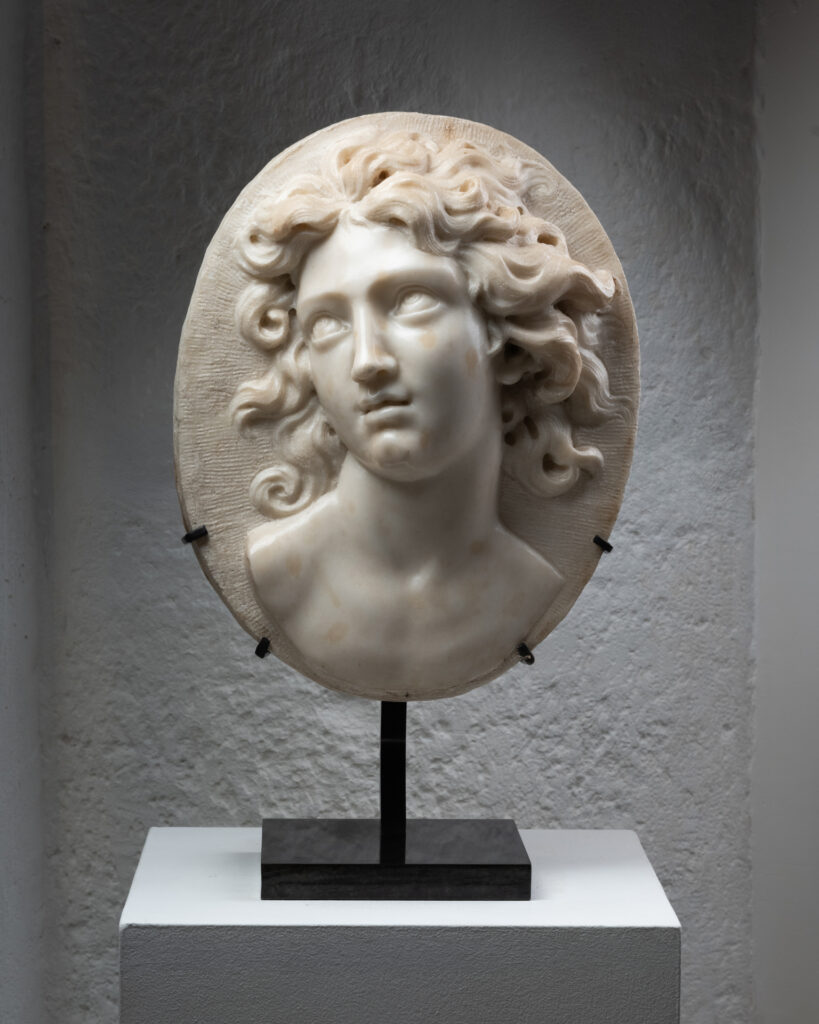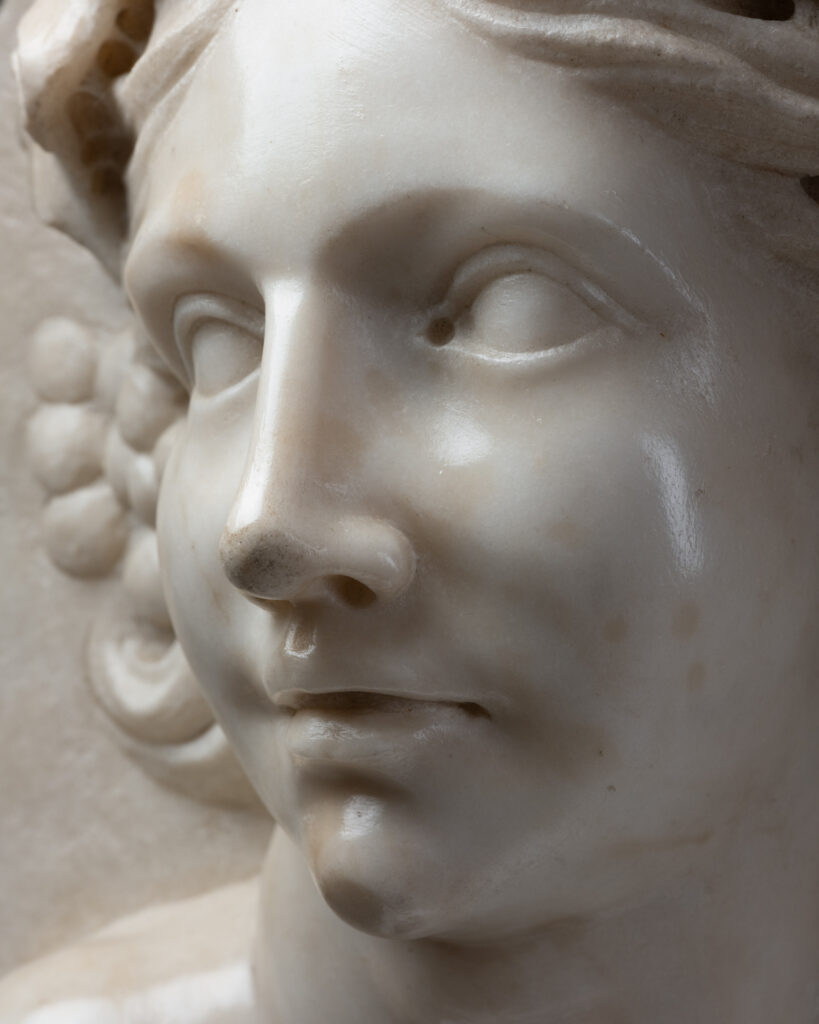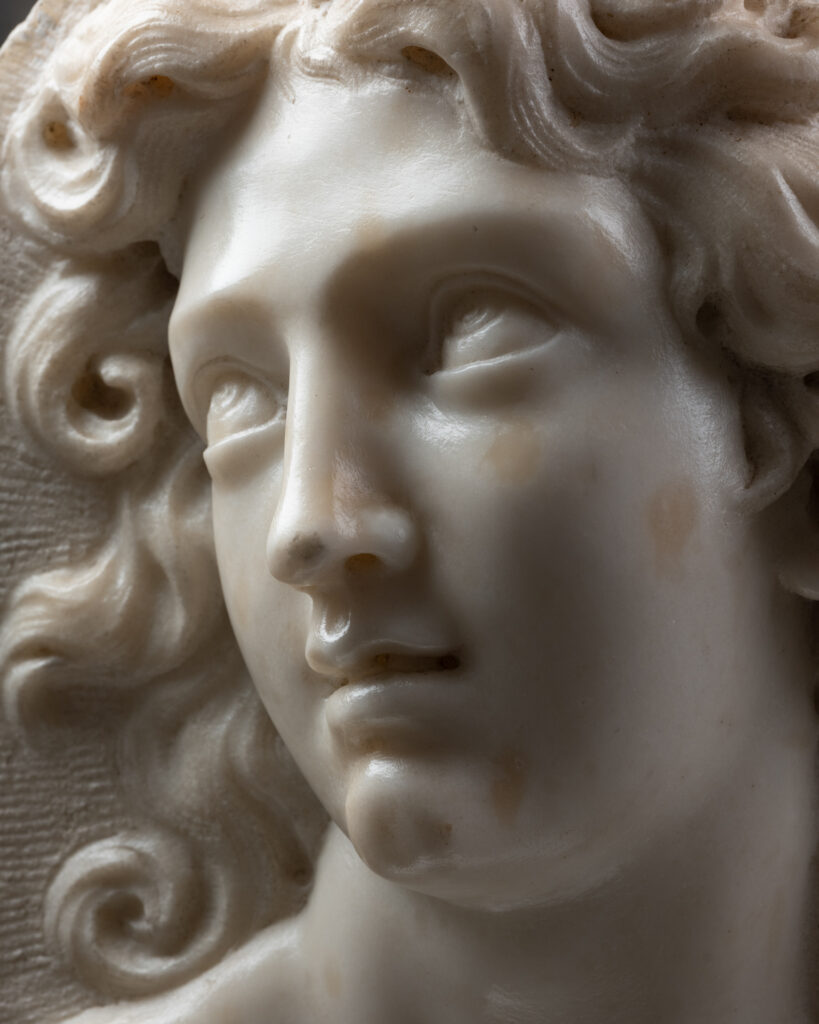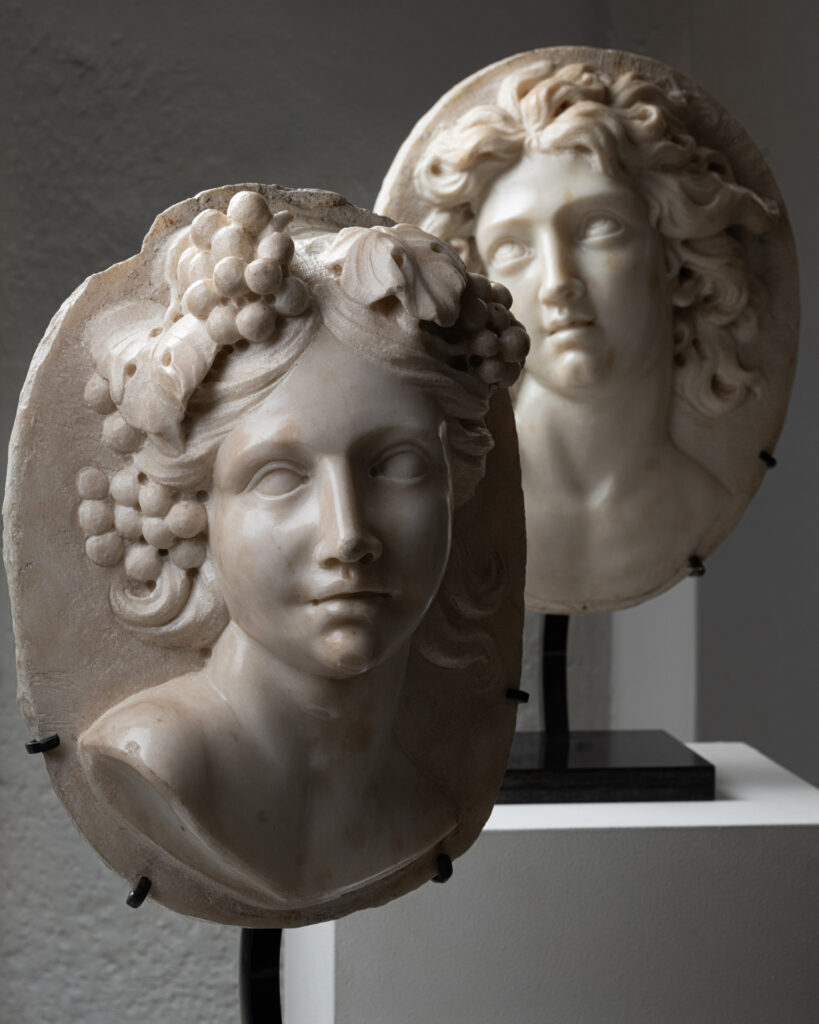

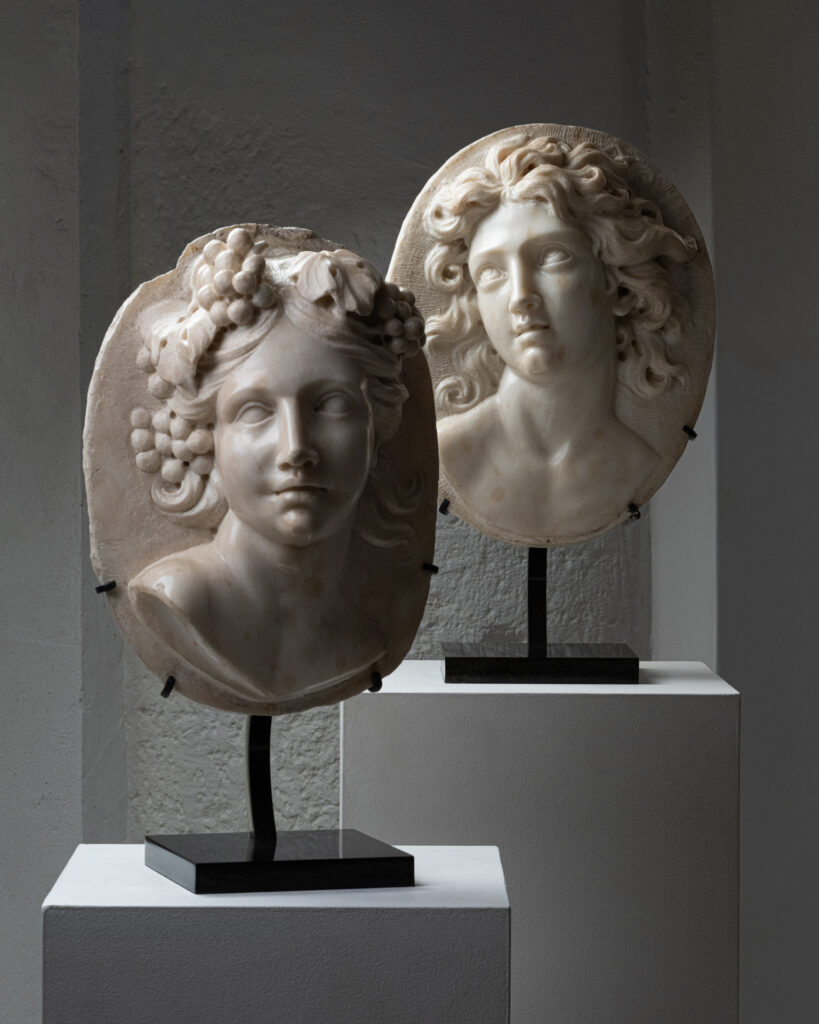
Oval in shape and carved from high-quality white marble, these two reliefs are distinguished by the remarkable projection of the faces—which appear almost detached from their background—and by the contrast between the delicate polish of the skin tones and the deeply carved, dynamic rendering of the hair. The female figure sports an elaborate hairstyle in which plant motifs appear to be interwoven, notably forms that can be interpreted as bunches of grapes. This distinctive feature suggests she may be a personification of Autumn, a hypothesis reinforced by the iconographic vocabulary of Italian decorative programs from the second half of the 17th century. The young man, with a youthful and idealized face, is characterized by long, wavy locks of hair that appear to be animated by movement. He stands out against a background crisscrossed by radiating streaks, evoking the diffusion of sunlight and suggesting the warmth and light characteristic of the summer season. In the absence of a more explicit figurative attribute, this conception allows for an allegorical interpretation of Summer: the figure’s youth and beauty, combined with the radiance surrounding him, contribute here to a personification of the season in its solar and luminous dimension.
The design of the two reliefs suggests that they were probably not intended to form a simple pair. The figures are looking in the same direction rather than facing each other, which could indicate that they were part of a larger decorative series, intended to be arranged within a architectural setting in a specific sequence. Their identification as personifications of the seasons reinforces this hypothesis. Examination of the reverse sides provides a particularly significant physical clue: the medallion identified as Summer bears the number 2 on its reverse, while the one identified as Autumn bears the number 3. This numbering, which corresponds precisely to the respective places of these two seasons in the traditional sequence of the Four Seasons, constitutes a particularly strong argument in favor of their belonging to a series of four allegorical reliefs, comprising Spring, Summer, Fall, and Winter. The two surviving works thus appear to be the second and third elements of a set that is now incomplete. The difference observed in the treatment of the reverse sides—one featuring a layered structure, the other not—is also consistent with elements designed to be mounted individually within an architectural setting, rather than with two works necessarily executed as a self-contained pair.
This hypothesis finds a particularly interesting echo in the work of the Venetian circle around Giusto Le Court. The sculptor and his circle are documented in several allegorical series combining the Four Seasons, ancient deities, and botanical motifs. A set of twelve white marble busts attributed to Le Court’s circle was thus intended for the staircase of a grand Venetian palace; it consisted of figures whose headdresses combined seasonal fruits and flowers with the attributes of deities from the Roman pantheon. This precedent offers a particularly significant parallel to the present medallions, both in terms of their allegorical design and the emphasis placed on the depiction of hair and botanical attributes.
These two reliefs are fully in keeping with the Baroque sculptural tradition of the second half of the 17th century, a period marked by a quest for movement, expressiveness, and a renewed relationship between sculpture and architectural space. Stemming from the great Italian tradition of Gian Lorenzo Bernini, this artistic language developed in Rome and then spread to Italy’s major artistic centers, notably Genoa and Venice, where sculptors such as Filippo Parodi pushed the art of marble carving to particularly spectacular heights of virtuosity. In Parodi’s work, as in these marbles, the faces seem to emerge forcefully from the background, while the hair—rendered in deep, undulating locks—gives the figures an impression of continuous movement. This approach to relief—which lies between the medallion and true sculpture in the round—is one of the most captivating features of the Baroque style and stylistically links these reliefs to that sculptural tradition.
During the Baroque period, the Seasons were a particularly popular theme in the decoration of palaces, villas, and aristocratic residences. They served as an elegant way to evoke the cycle of nature and time, as well as abundance, fertility, pleasures, and the renewal of life. Often associated with gods and mythological figures, they fit naturally into decorative schemes designed to celebrate the proper order of the world, prosperity, and the owner’s prestige. Their instantly recognizable nature also made them an ideal subject for sculptural cycles, galleries, and monumental staircases, where multiple figures could interact while forming a cohesive decorative whole.
The sculptor also uses a trepan, a type of drill operated by hand with a bow. This tool has been used since ancient times to reach recesses, clear hard-to-reach areas, and rough out small-diameter grooves by forming cylindrical cavities. Slow but precise, the trepan is intended for use on very fragile areas and hard materials such as wood, stone, and marble. The trepan technique adds movement and depth to the overall work.
The treatment of the faces, the pronounced three-dimensionality, the free rendering of the hair, and the contrast between the polished surfaces and the deeply carved areas reflect a fully Baroque style, characteristic of Italian sculpture from the second half of the 17th century. The sculptural quality of the two figures and their conception as elements of a broader decorative program thus invite us to view them not as two isolated portraits, but as the surviving fragments of an allegorical ensemble that is now scattered. The young man, in particular, stands out for his almost ecstatic expression and his gaze directed toward the sky, accentuated by the subtle twist of his face and the sweep of his hair. This pose evokes the Baroque taste for figures captured in a state of tension or emotional abandon, and can also be compared to the high-relief adaptation of the ancient type of the bust of the Dying Alexander: the same intensity of gaze, the same youthful idealization of the features, and the same desire to make the head emerge from the field with an almost autonomous presence. This conception finds a particularly interesting parallel with two marble reliefs housed at the Art Institute of Chicago, which are also conceived as strongly projecting heads, almost detached from their background, and whose facial modeling, expressiveness, and treatment of the hair show significant affinities with the marbles in question.
The presence of grape clusters and vine leaves in the female figure’s hair provides a particularly interesting iconographic clue suggesting a personification of Autumn, in the guise of a Bacchic figure or a Bacchante. The young man, for his part, bears no specific figurative attributes, but stands out against a background crisscrossed by radiating streaks, evoking the sun’s rays and suggesting the warmth and light of summer. His youthful beauty, combined with the radiance surrounding him, thus lends itself to an interpretation as a personification of Summer. Both seem to gaze beyond the frame of the medallion, in the same direction: this shared orientation creates a subtle dialogue between the two figures and lends the composition a true visual unity. The contrast between the idealized softness of the faces and the power of the hair—sculpted with depth and animated by an almost ethereal movement—further enhances their presence. Together, these two faces seem to belong to the same cycle, gazing toward a shared horizon, as if carried away by the passage of time and the perpetual renewal of the seasons.