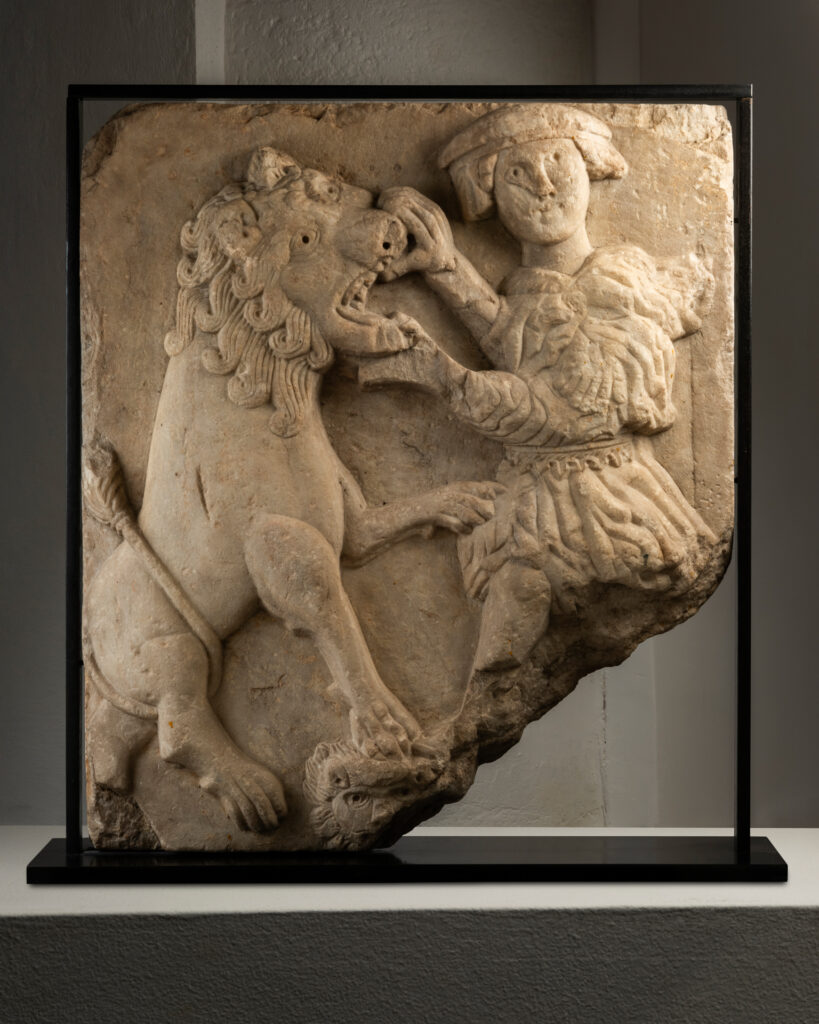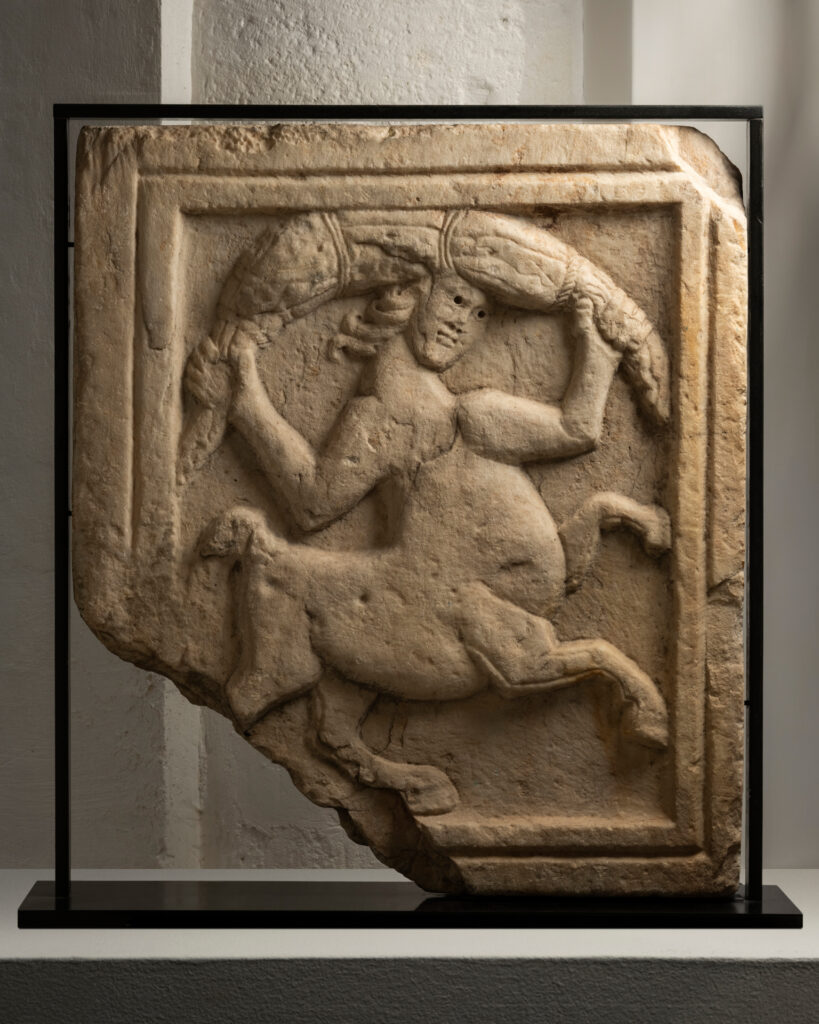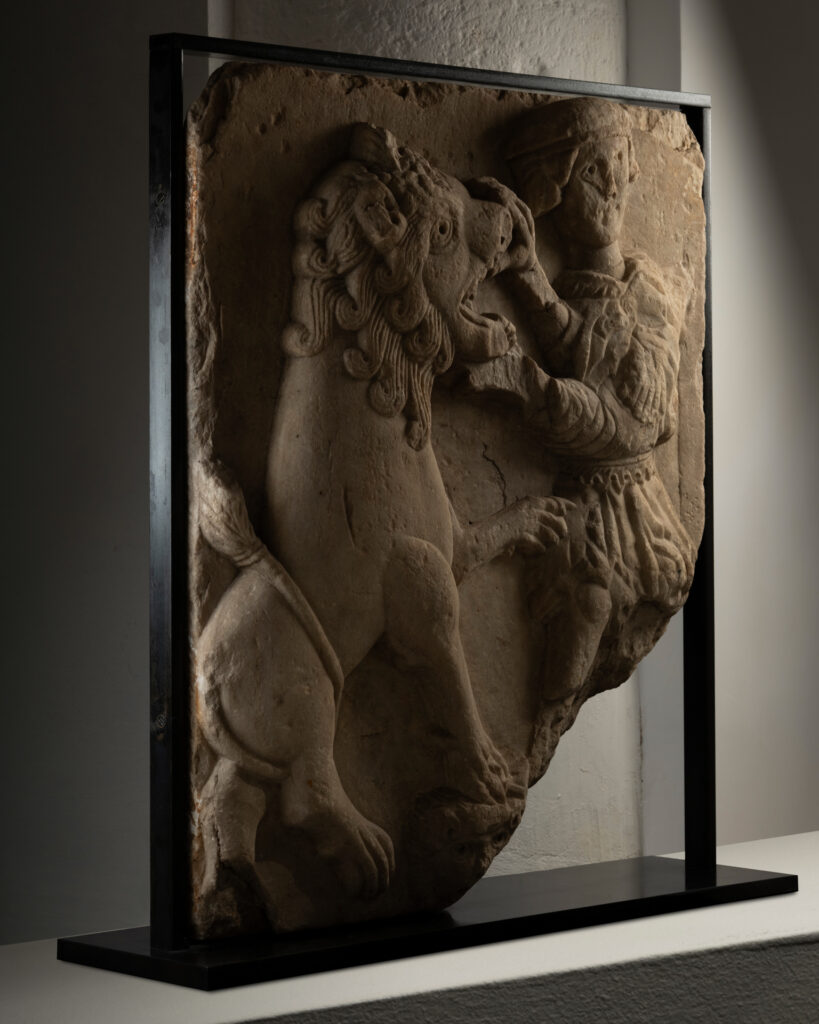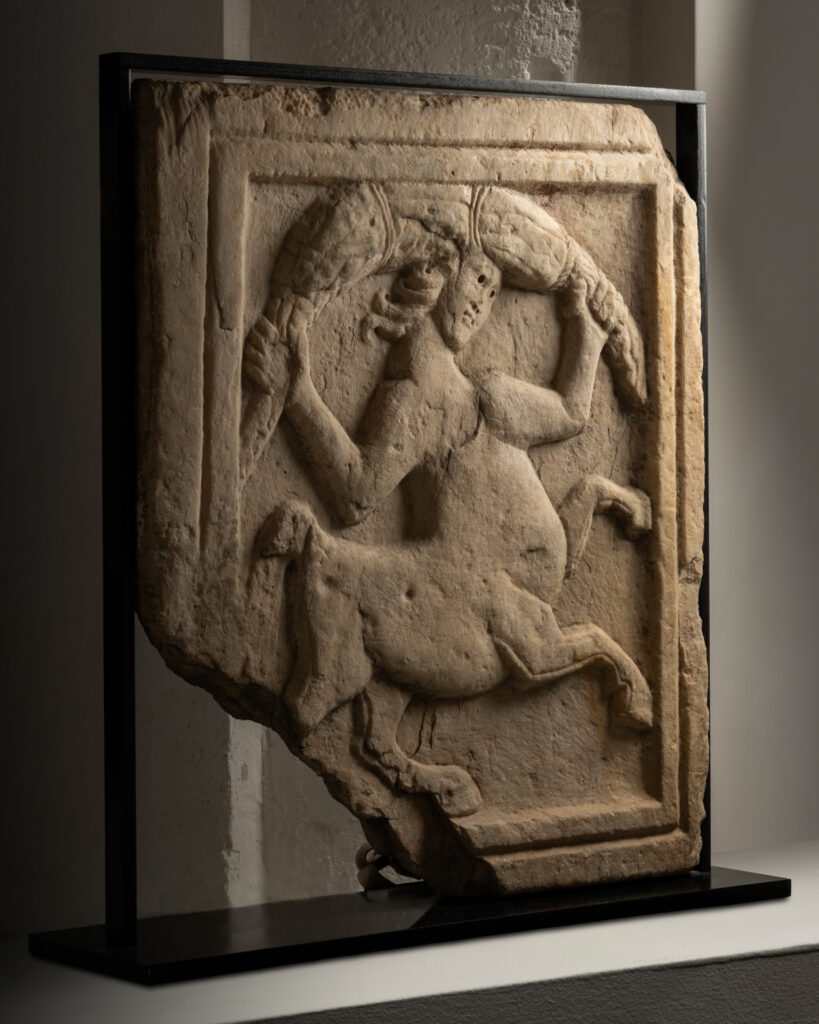

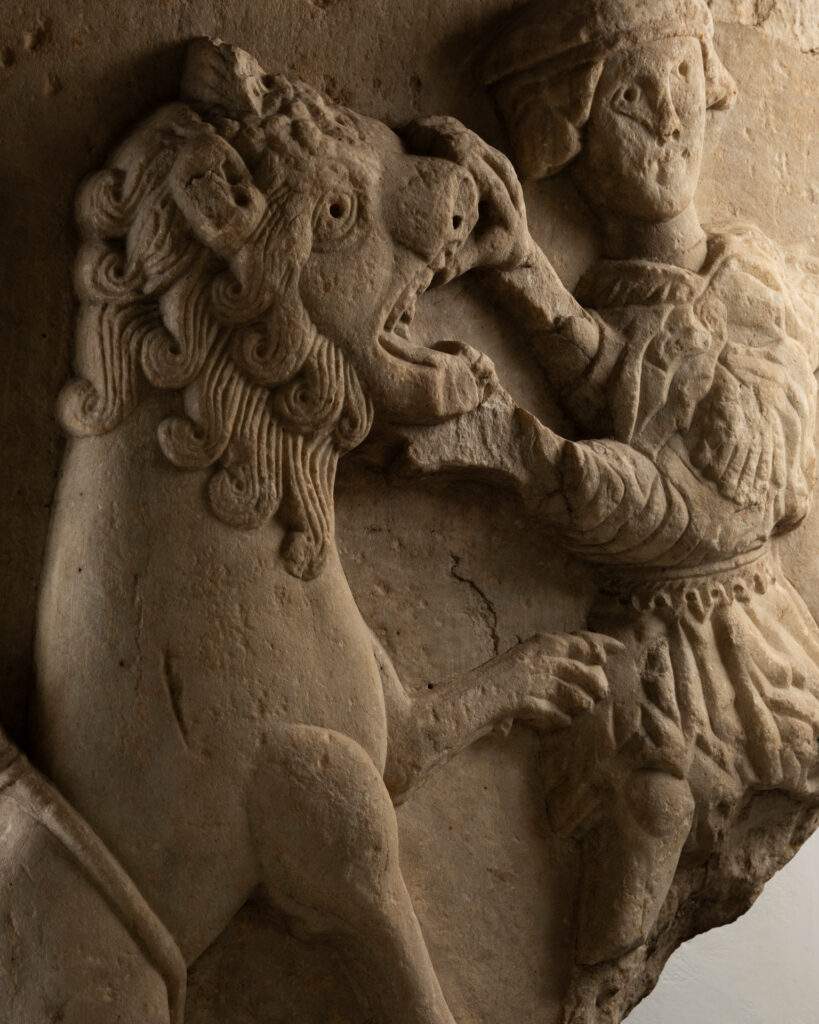
This double-sided marble pluteus dates from the 12th century and likely originates from northern Italy, a region that was particularly active in the production of liturgical sculptures during the Middle Ages. As an element of the liturgical enclosure, it was incorporated into the church’s architecture to demarcate the sacred space of the choir.
In Romanesque architecture, the pluteus serves more than a mere decorative function: it marks a symbolic and moral boundary between the world of the faithful and the sacred realm, while also serving as a medium for a visual narrative with a catechetical purpose. The choice of a double-sided sculpture is no accident; it invites an interpretation based on contrast, prompting the faithful to confront two possible states of the human soul as they move around the object. In the marble, the hollowed-out eye sockets are filled with lead or glass beads, and the figures’ fixed gazes are illuminated by a discreet and mysterious life that seems to scrutinize the faithful.
The Romanesque relief is part of an iconographic tradition shared throughout the Mediterranean basin, where the figure of the hero confronting the wild beast—from Digenis Akritas in the Byzantine world to David in the Latin West—symbolizes the victory of moral order over the forces of chaos.
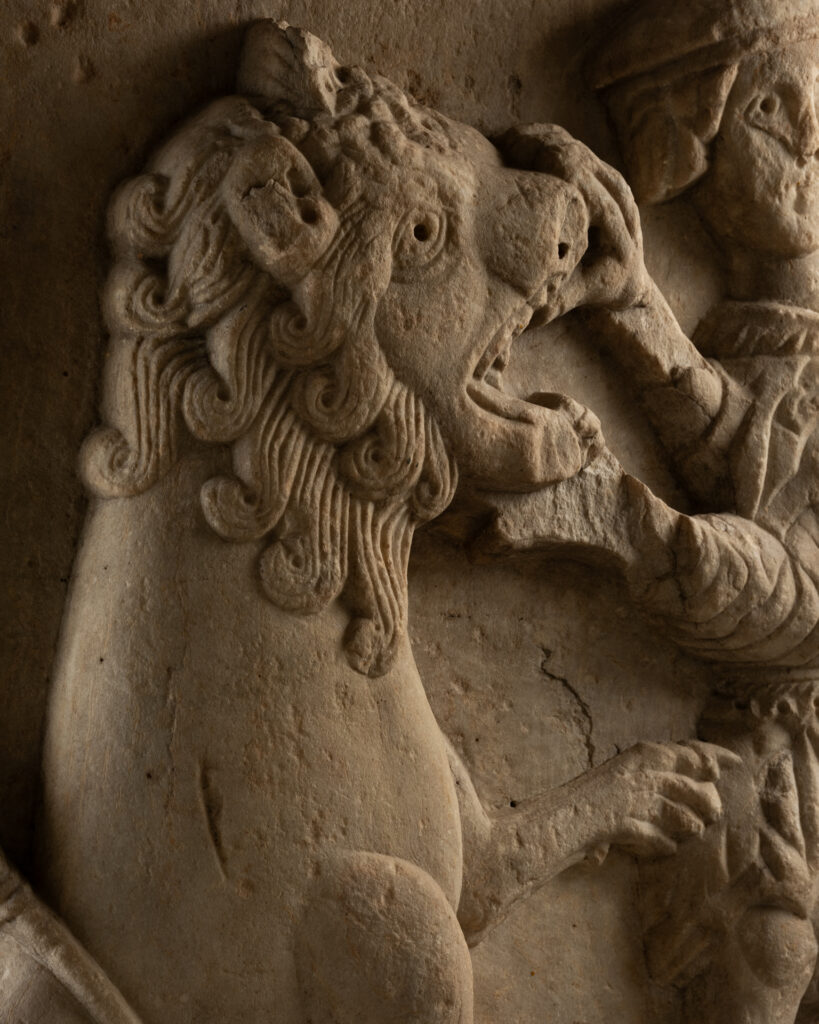
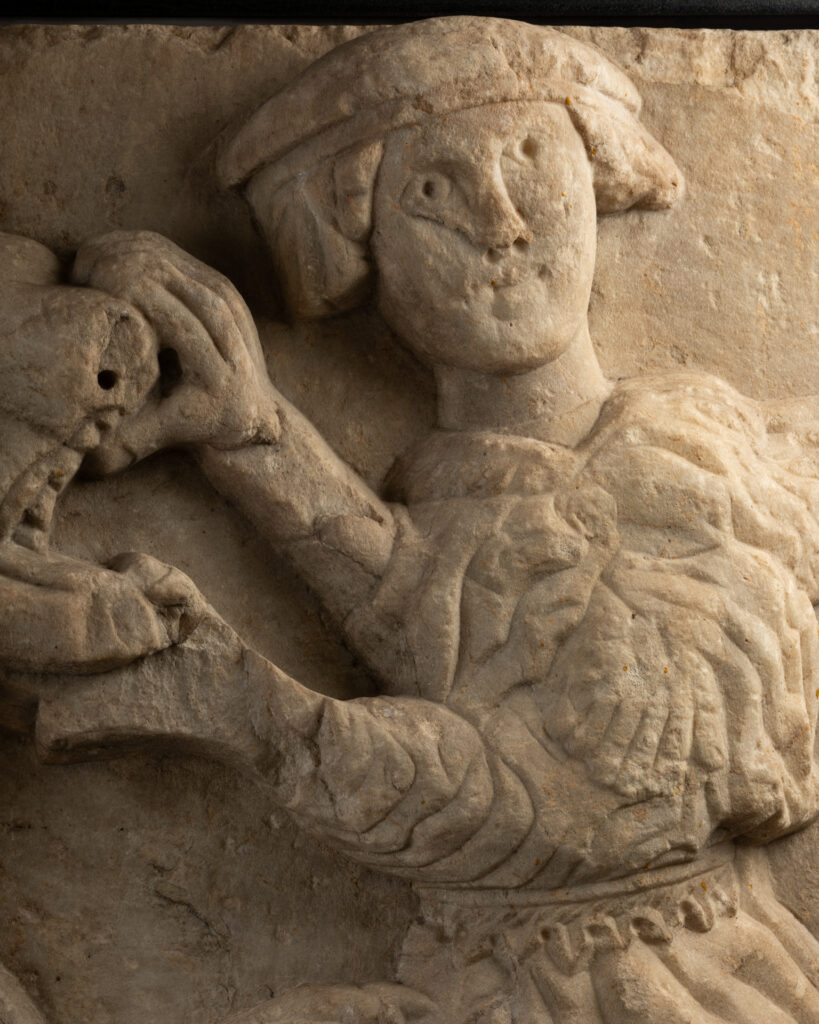
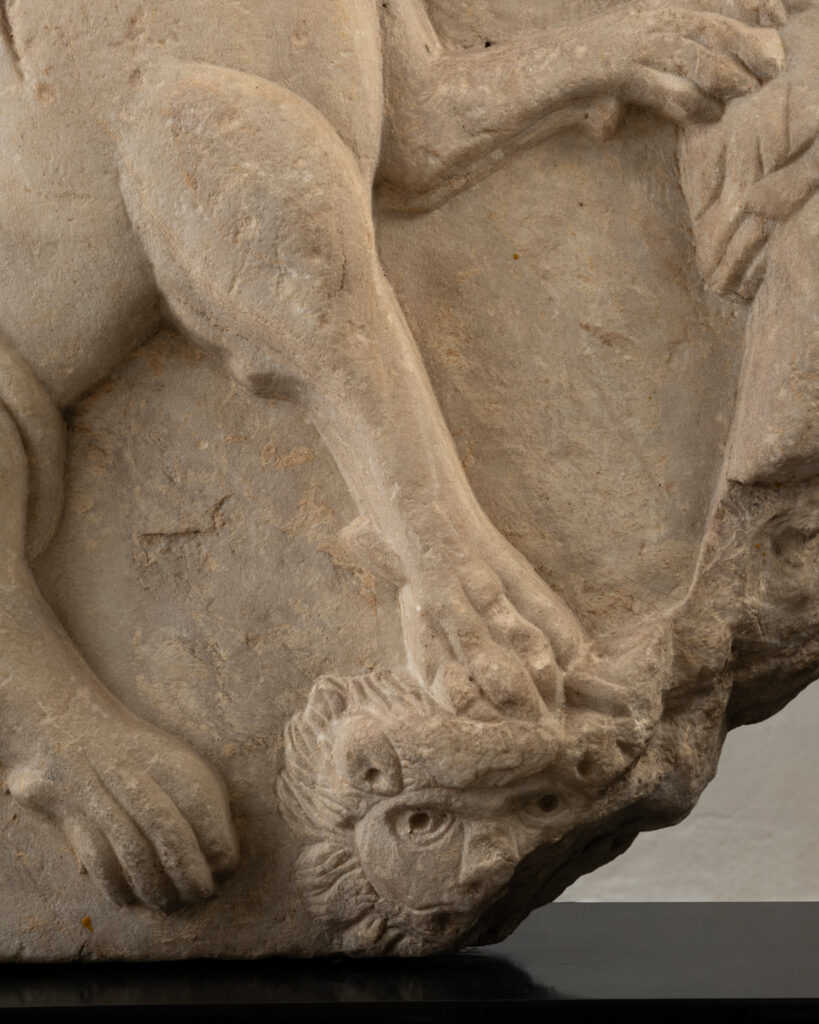
The obverse depicts the young shepherd David fighting a lion and a bear, a scene directly inspired by the Old Testament (1 Samuel 17:34–36), in which David recounts how he saved his flock from wild beasts. The simultaneous presence of the lion and the bear allows for clear identification of the figure and rules out any confusion with Samson or Hercules.
In biblical tradition, David is the second king of Israel, the successor to Saul, chosen by God to rule his people. In medieval Christian exegesis, he occupies a central place as a foreshadowing of Christ and a direct ancestor of Jesus. His figure thus combines earthly kingship with divine election, making him a model of a just and inspired ruler. His life, recounted as a narrative that is both heroic and spiritual, profoundly shaped medieval Christian iconography, where David is frequently associated with the Psalms, particularly those evoking the Nativity, the Virginity of Mary, or, more symbolically, the Passion of Christ. This prophetic dimension reinforces the theological significance of his battles, interpreted as a foreshadowing of the salvation brought by Christ.
This theological interpretation naturally extends to the symbolic reading of the battle scenes associated with David’s youth: his struggles are interpreted as a foreshadowing of Christ snatching humanity from the jaws of the devil. The lion and the bear, wild and menacing animals, embody the forces of evil. David’s battles against the lion and the bear possess a strong symbolic dimension: by saving the threatened lamb, he embodies the protection of the flock and the victory of virtue over bestial forces. The lion and the bear evoke both royalty and power, but above all uncontrolled savagery, opposed to divine order.
In the Middle Ages, the lion was typically portrayed in a negative light, drawing on references from the Old Testament. For most of the Church Fathers, it embodied evil and cruelty: “Deliver me from the lion’s mouth,” the Christian implores in a psalm. The victorious battle against a lion that crowns a hero symbolizes the victory of good over evil. It was not until the 12th century, under the influence of the Church, that the lion became the king of the animals.
The bear was also heavily demonized in the Middle Ages; its shaggy appearance and dark color came to symbolize a bestiality associated with the deadly sins, to the point that the Devil could be depicted in the form of a bear. David, for his part, triumphs not through brute force but through faith, embodying victorious virtue and serving as the model of the faithful Christian. This scene is fully in keeping with the tradition of the Psychomachia, the allegorical battle between vices and virtues theorized by Prudence, which profoundly shaped the medieval imagination.
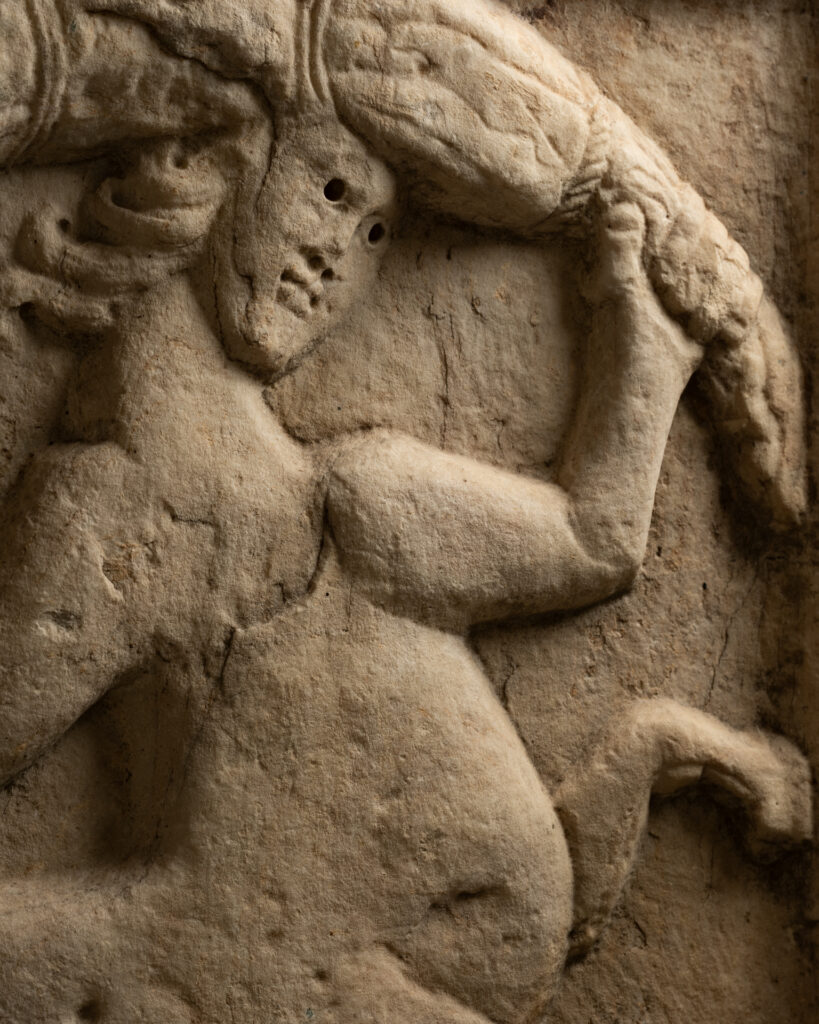
The reverse side depicts a centauress, a hybrid figure that is half-human and half-animal, carrying a heavy and deliberately undefined burden. This vagueness is not the result of carelessness, but rather a deliberate iconographic choice consistent with Romanesque thought and aesthetics. The burden does not refer to a specific narrative episode; it functions as a sculpted abstraction, intended to make an immaterial reality visible.
Sagittarius, relief, Anonymous, before 1120, Musée des Augustins, Toulouse Bayeux Tapestry, Anonymous, between 1066 and 1083, Bayeux Museum In medieval Christian thought, hybrid beings—centaurs, sirens, or satyrs—were frequently used as symbols of vice in moral allegories. Inherited from antiquity, the figure of the centaur underwent a profound transformation: whereas it could be noble or heroic in ancient mythology, in the Middle Ages it became the image of moral disorder and lust.
The centauress thus embodies the duality of the human soul, torn between reason and animal instinct. The burden she bears does not refer to a specific narrative element but to a well-known theological concept in Romanesque iconography: that of the invisible weight made visible. Saint Augustine asserts that “my weight is my love,” while Gregory the Great compares sin to a burden that bends the soul.
The unidentifiable burden thus becomes a symbol of sin itself—invisible by nature but made perceptible through the sculpture. Associated with a hybrid creature traditionally linked to lust, envy, and the domination of instinct, the burden it bears embodies the spiritual consequences of surrendering to the flesh. The theme echoes that, widely prevalent in Romanesque art, of the animalization of the sinner: when sin and the flesh prevail over the spirit, man is reduced to the status of a beast.
From a stylistic perspective, this pluteus could be attributed to a workshop in Northern Italy rooted in the tradition of Wiligelmo, but it exhibits characteristics more closely aligned with the work of Niccolò, his pupil. Indeed, one observes a softening of the rigidity and dramatization characteristic of Wiligelmo, in favor of a more supple modeling, less angular folds, and a more legible narrative. This evolution is accompanied by a transformation of Byzantine symbolism: without adopting Byzantine non-spatiality, the sculpture retains its allegorical significance, expressed here through simplified and expressive forms intended to convey a moral reality rather than to depict the actual world. This more nuanced and accessible visual language is more in keeping with Niccolò’s style, who adapts his master’s legacy to a sculpture that is more didactic and less abrupt.
The entire pluteus thus functions as a sculpted antithesis. On one side, David, a figure of faith and moral victory; on the other, the centauress, the embodiment of the Fall and spiritual ruin. Through this confrontation, the Romanesque sculptors carved a clear warning into the stone: as the faithful approach the sacred space, they are invited to reflect on the inner struggle between virtue and vice, salvation and damnation. The pluteus thus becomes a true tool of visual catechesis, transforming sacred architecture into a space for moral reflection.