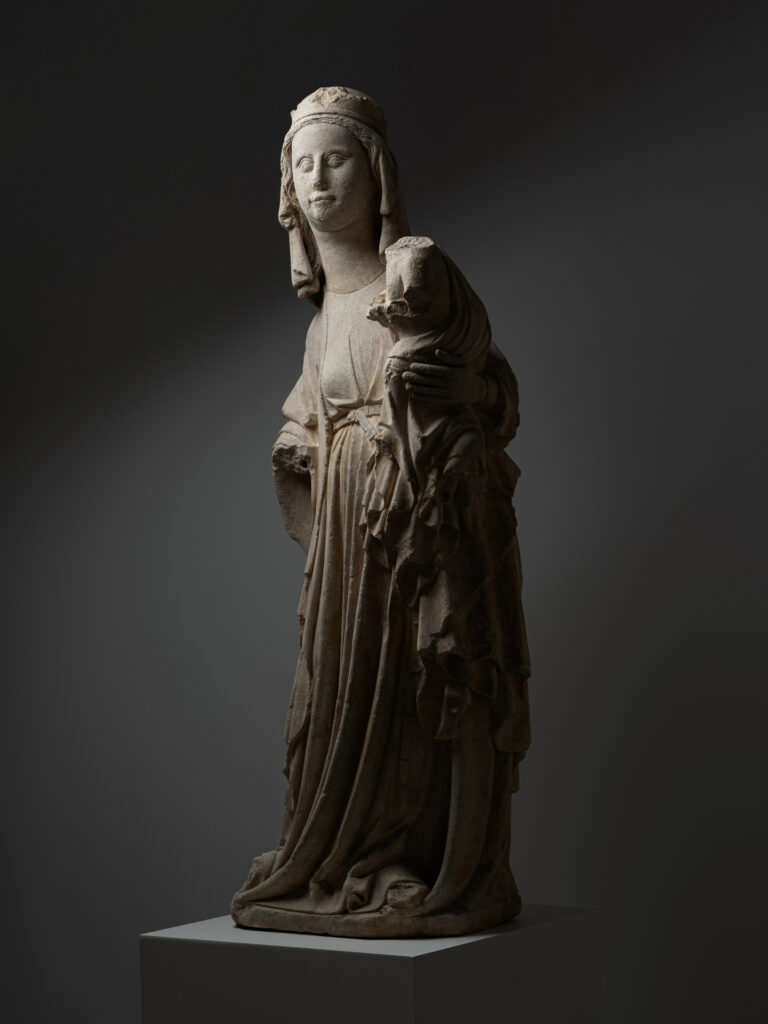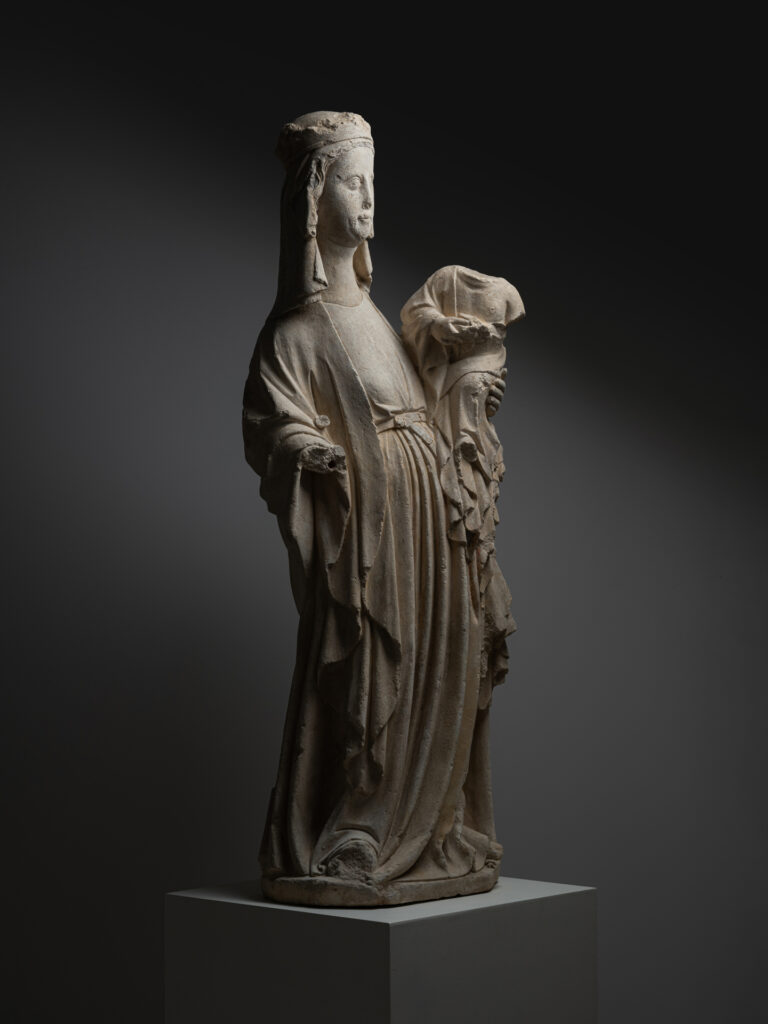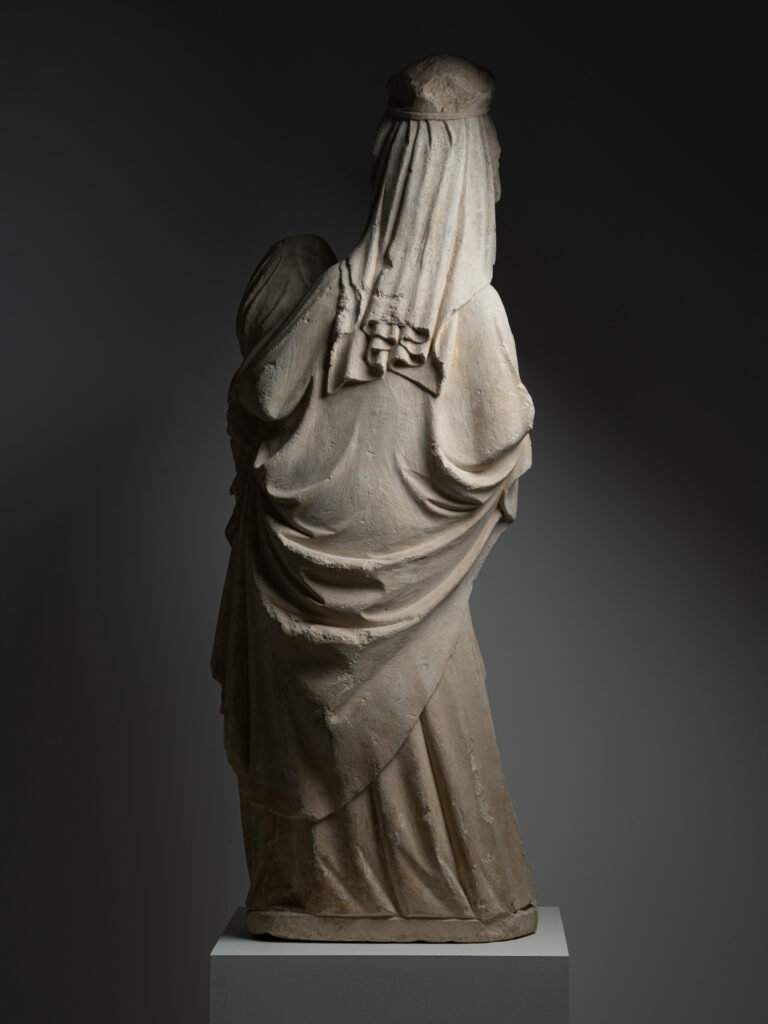

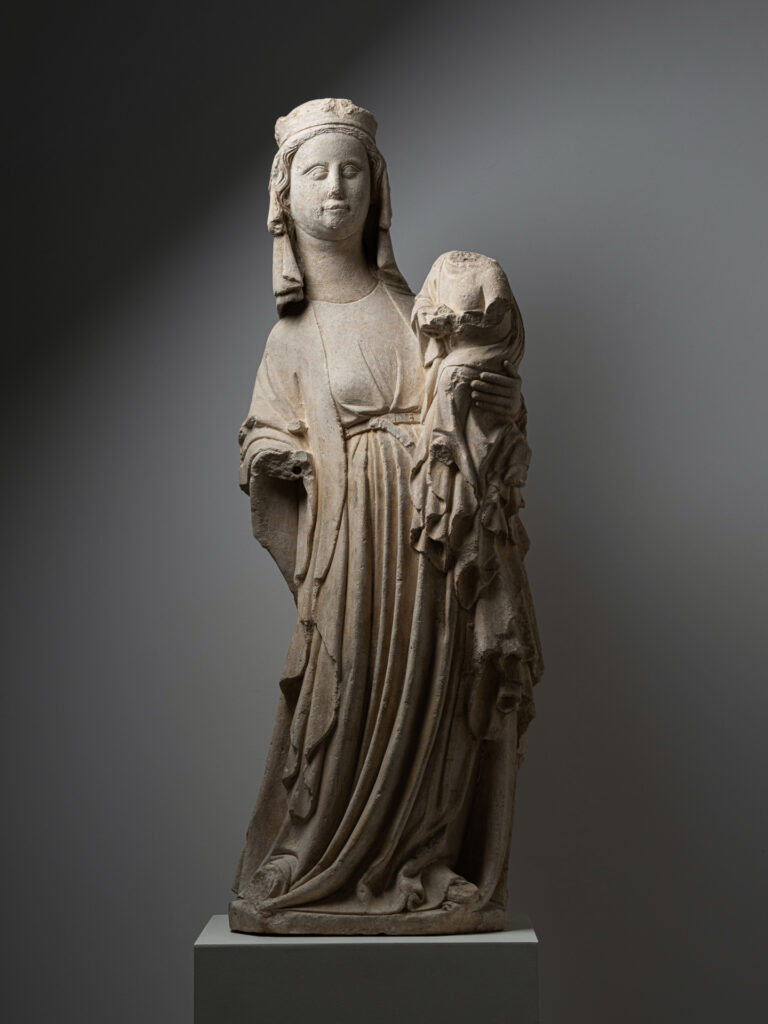
This Virgin and Child is a remarkable medieval sculpture dating from the early 14th century and attributed to a workshop in Lorraine. Carved from very fine, soft limestone, it demonstrates the high technical quality achieved by sculptors in this region, which was particularly active artistically at the time. Slight traces of polychromy remain in the most pronounced folds, reminding us that these sculptures were originally painted and intended to be rich and expressive to the eye.
The work was created at a time when Marian devotion was widespread, with the Virgin and Child being the most common religious image of the Middle Ages, becoming increasingly popular from the 10th century onwards. Designed as an image of the Virgin, it was intended to represent one of three depictions of Christ alongside the Virgin in Majesty and the Crucified Christ.
The Virgin is depicted in the classical style of the Madonna: she stands upright, her body slightly turned in a pronounced contrapposto, while carrying the Child on her left arm. This posture creates a supple sway in her silhouette, while maintaining an impression of stability. The proportions appear deliberately somewhat massive, with a widening of the lower part of the body, a well-known characteristic of Lorraine Virgins of this period.
The cloak, draped over her shoulders, is open and reveals her chest, revealing a belted dress. The belt is an essential iconographic element here: placed high on the waist, it is partially concealed by the figure of the Child. It accompanies the movement of the body and helps to structure the verticality of the composition. In Marian iconography, the belt traditionally refers to the Virgin’s chastity and purity, while emphasizing the symbolic separation between the upper body, the seat of the spirit, and the lower body, which is more carnal. The very short veil, with its ample folds, is held in place by a simple diadem, a discreet attribute of Mary’s royal dignity.
Mary’s face, broad and relatively flat, is distinguished by a powerful forehead, a small nose and mouth, and a double chin without disgrace, giving the expression a gentle, serious, and human quality. This physiognomy, common in Lorraine sculpture, departs from the idealized elegance of Parisian art in favor of a carnal and three-dimensional presence. The statue, carved in the round, is designed to be viewed from all sides, occupying the entire space and requiring no architectural setting.
The head of the Child is now missing, a common occurrence in medieval Marian statuary. Iconoclastic episodes often targeted the figure of Christ, the direct image of God, while the Virgin was more readily spared. The Child’s half-naked body is wrapped in a lavish drape, whose proliferation of folds extends and blends into those of the Virgin’s robe, creating a visual continuity between the two figures and reinforcing their symbolic unity.
In his hand, the Child holds a bird, an iconographic motif frequently interpreted as a foreshadowing of the Passion, referring to the soul, sacrifice, and the foretold death of Christ. Mary’s missing right hand probably held a flower-shaped scepter, of which only the tenon remains today. A common Marian attribute, it would have contributed to the overall balance and formal tension of the ensemble.
This work also reflects the intense cultural exchanges that Lorraine enjoyed at that time, under the rule of the Counts of Bar, with links to the Germanic regions, Flanders, and England. The Germanic influence can be seen in the solidity of the volumes, the plastic density, and the assertive spatial presence of the figure, while remaining deeply rooted in local tradition. Probably intended for a parish church, cathedral, or monastic chapel, it illustrates the devotional function of these sculptures, designed as aids to meditation and prayer.
Thus, through its monumental presence and human warmth, this Virgin and Child powerfully embodies the spirituality and refinement of Lorraine sculpture at the turn of the 14th century.